Marandang Basamo: IPB University and PAPMM Prepare One Ton of Rendang for Disaster Victims in Sumatra
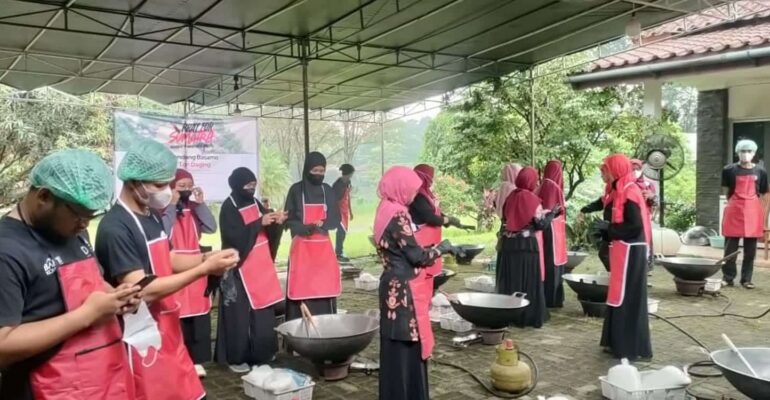
IPB University and the Minang Student and Alumni Association (PAPMM) initiated a humanitarian movement called “Marandang Basamo” by producing one ton of beef rendang to be distributed to disaster victims in West Sumatra, North Sumatra, and Aceh.
A total of 150 volunteers from lecturers, students, alumni, and the community of Greater Jakarta participated as a form of concern for their fellow countrymen affected by the disaster.
The acting rector (Plh) of IPB University, Prof Ernan Rustiadi, expressed his appreciation for the cross-sector collaboration involved.
“Sumatra has a very strong connection with IPB. Many of our students, lecturers, and alumni come from West Sumatra and North Sumatra. Therefore, what happens there is part of our extended family. IPB will always be there to contribute,” said Prof Ernan.
He added that IPB University not only plays a role in distributing logistical aid but is also actively sending teams to the field and coordinating with seven universities assigned as support posts for disaster-affected areas.
The rendang produced in this activity not only emphasizes nutritional aspects and cultural value but also food safety and shelf life. The packaging process was carried out in collaboration with the Faculty of Agricultural Technology (Fateta) IPB University and the Mitra Tani (MT Farm) facility in Tegalwaru using vacuum and sterilization methods, so that the product can last up to two years.
“IPB’s food technology is able to respond to challenges in emergency situations. We hope that this contribution will provide tangible benefits and help accelerate the recovery of communities affected by disasters,” he said.
Vice Chair of PAPMM, Fadli Afriadi, explained that this movement originated from an initiative by IPB Minang alumni, which then received widespread support from lecturers, influencers, and the business world.
“For the Minang community, rendang is not just food, but a symbol of tradition, solidarity, and togetherness. We hope that this rendang can be a source of moral support for disaster victims,” he said.
Meanwhile, the initiator of Marandang Basamo, Rindang Matoati, SE, MSi, said that innovations in the processing and packaging of rendang were made so that the aid could be optimally utilized by the affected communities.
“We ensure that this rendang is safe, hygienic, and durable. The hope is that the aid can truly be consumed properly, not wasted, and can be stored for the long term,” explained the lecturer from the Faculty of Economics and Management at IPB University.
In addition to rendang, the committee is also working to add IPB University’s innovative instant rice so that the aid can be distributed in the form of ready-to-eat meal packages.
The distribution of aid is carried out through a network of volunteers, including the Minang influencer community, as well as various humanitarian platforms to ensure that the aid is distributed appropriately and provides maximum benefit to the affected communities. (AS) (IAAS/KQA)