
IPB University, UI, and ITB Disseminate Water Quality Research Results in DKI Jakarta
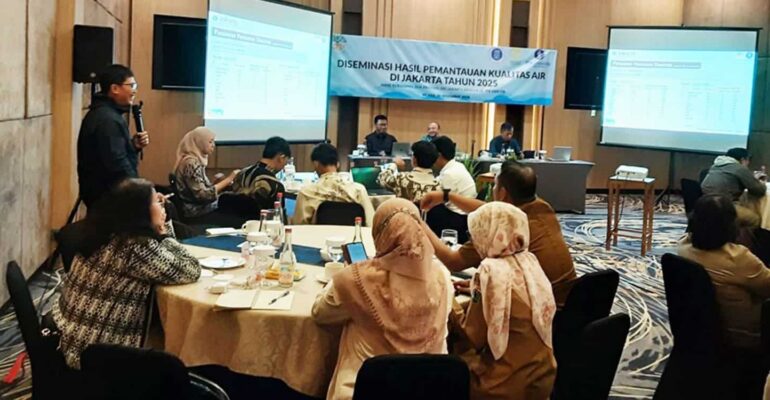
The Center for Environmental Research (PPLH), the International Research Institute for the Environment and Climate Change (LRI LPI) at IPB University disseminated the results of DKI Jakarta’s water quality monitoring in 2025.
This program is a collaboration between the DKI Jakarta Provincial Environment Agency (DLH), PPLH IPB University, Lemtek Universitas Indonesia (UI), and the Directorate of Community Service and Expertise Services (DPMK) of the Bandung Institute of Technology (ITB).
The dissemination event, held at Oakwood Hotel, East Jakarta (11/25), was attended by representatives from the Ministry of National Development Planning/National Development Planning Agency (PPN/Bappenas), the Ministry of Environment, the Directorate General of Water Resources of the Ministry of Public Works (Directorate of Groundwater and Raw Water and the Ciliwung Cisadane River Basin Agency (BBWSCC)), the Coordinator of the Special Staff of the Governor of DKI Jakarta, and related Regional Work Units (SKPD).
Heavily Polluted
Vice of the Jakarta DLH, Dudi Gardesi Asikin, said that currently the quality of river water, reservoirs, and groundwater is dominated by heavy pollution. For river water and reservoirs, several parameters that do not meet water quality standards include phenol, total phosphate, total nitrogen, biological oxygen demand (BOD), coliform bacteria, and fecal coliform bacteria.
This condition is mainly caused by grey water wastewater (domestic wastewater that does not contain feces or urine from bathtubs, showers, bathroom sinks, and washing machines) that has not been properly managed. This is followed by the community’s behavior of disposing of waste indiscriminately and the waste management system by MSMEs and settlements that has not been properly managed.
During the dissemination presentation session, Dr Liyantono, Executive Secretary of PPLH IPB University, attempted to divide the rivers in DKI Jakarta into six clusters to facilitate the determination of management priorities. This division was based on the typology (characteristics) and pollution levels of the river sections.
River characteristics are defined by the width, depth, bends, and flow velocity of the observed river section. This typology is then linked to the pollution index (PI) value of the river section measured at a specific point.
“For example, the correlation found in the Cideng River section is predominantly heavily polluted. This is in line with the condition of the water, which has a slow flow and relies solely on grey water from residents,” explained Dr Liyantono.
Another finding, according to Dr Liyantono, is that community behavior towards domestic waste management and sanitation is relatively similar. Pollution issues are more influenced by community behavior and awareness.
Furthermore, the existence of septic tanks that do not meet standards creates the potential for septic tank seepage into groundwater, which has the potential to cause pollution. Lemtek UI also found fecal coliform bacteria in residents’ groundwater.
“The presence of these coliform bacteria should not exist at all in groundwater according to the regulations of Ministry of Health Regulation No. 2 of 2023. Interestingly, based on the team’s findings, greywater drainage systems sometimes mix with urine drainage systems (BAK),” he added.
In addition, open defecation was found during monitoring of water quality in reservoirs in DKI Jakarta. According to IPB University researcher Dr Zaenal Abidin, in the Rawa Kepa Reservoir, for example, many grey water and black water channels were found to flow directly into the reservoir through household piping.
This increases the potential for elevated levels of coliform bacteria and fecal coliform bacteria in the water body, which are harmful to human health. “Efforts to provide communal septic tanks and waste management systems must be widely implemented to achieve better environmental quality,” he explained. (*/Rz) (IAAS/KQA)

