
IPB University Researchers Reveal the Potential of White Jasmine for Health and Cosmetics
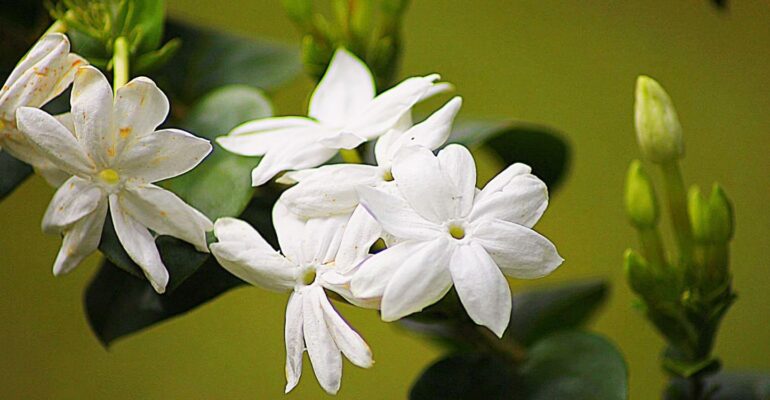
Who doesn’t know white jasmine? This flower, with the Latin name Jasminum sambac, is so popular in Indonesia that it has even become the national floral symbol, ‘Puspa Bangsa’.
Professor Ani Kurniawati, a distinguished professor at the Faculty of Agriculture, IPB University, noted that besides being widely used for various religious ceremonies/rituals, weddings, and as decorative flowers, this type of jasmine is also frequently utilized as raw material for essential oils and cosmetics.
“White jasmine has a relatively high essential oil content, a short flowering period, and a distinctive aroma, which has increased its demand both domestically and internationally,” she explained in a written interview with the IPB Today editorial team.
Furthermore, this researcher on cosmetic raw materials said that jasmine and several other plants, such as ylang-ylang, mangosteen peel, black cumin ‘habbatussauda’, jicama, patchouli, ginger, and turmeric, are examples of plants that have potential as cosmetic ingredients. Various studies on the agronomy of supplying these raw materials have also been conducted.
According to Prof Ani, the trend of natural-based cosmetics is now growing rapidly on a global scale. The natural biocosmetics market is projected to reach over USD 54,5 billion by 2027.
“White jasmine is one of Indonesia’s potential ingredients due to its bioactive content, which acts as an antioxidant, anti-inflammatory, antibacterial, anti-aging, and skin brightener,” she explained.
According to digitani.ipb.ac.id, jasmine has various health benefits. The soothing aroma of jasmine can help relieve stress. Research shows that jasmine has antioxidant properties that can help reduce the risk of cancer.
The antioxidant content in jasmine also plays a role in slowing down the aging process. In addition, jasmine can also be used as a natural deodorant.
Prof Ani hopes that the exploration of other types of jasmine can be developed for ornamental plants, health, and cosmetic purposes. Jasmine typically grows in warm climates. It is widely cultivated in Central Java regions such as Tegal, Pemalang, Batang; Pamekasan, Madura; and Pasuruan, East Java. (dh) (IAAS/KQA)

