
IPB University Forestry Expert Strengthens Indications of Illegal Logging Behind Findings of Logs After Disaster in Sumatra
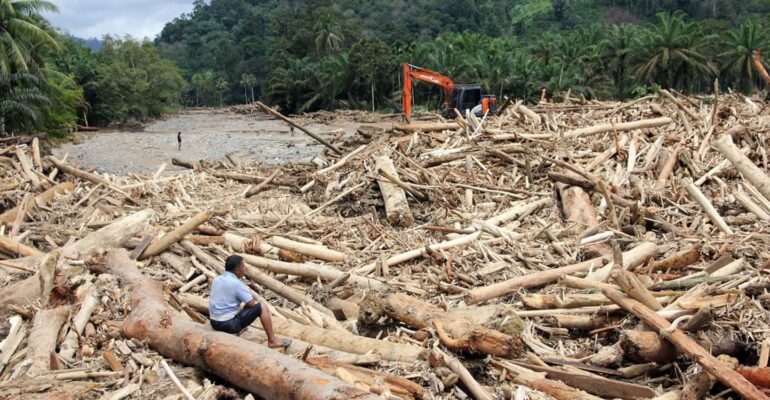
Professor Bambang Hero Saharjo, Professor at the Faculty of Forestry and Environment and Chairman of the IPB University Disaster Study Center, assessed that the characteristics of the wood found at the disaster site in Sumatra indicate human involvement.
He emphasized that this condition cannot be fully explained as rotten wood or the impact of natural collapse.
In his explanation, Prof Bambang linked the findings to a similar case he handled several years ago in a protected area in North Sumatra.
He described that healthy forests have a dense and tiered canopy structure, which is able to break up and hold back the flow of rainwater. “Even though there is water, it does not go directly to the surface. It falls on the canopy, breaks up, and then some of it flows through the trunk or stem flow,” he explained.
Prof Bambang added that the presence of undergrowth and litter plays an important role in absorbing water and maintaining the stability of the forest ecosystem.
According to him, the layered vegetation, from the upper canopy to the undergrowth, is a natural support system that maintains environmental balance.
“God created this, of course, for the good of humans and the environment,” he said.
Furthermore, he explained that the fall of one or two trees in natural conditions does not pose a threat to the ecosystem. “These trees, yes, even if they fall, it’s not many. At most only one or two. And that’s natural,” he said.
Prof Bambang explained that the strong root systems of old trees keep the forest stable, and when one tree falls, the empty space is immediately filled by new species regeneration.
However, he continued, problems arise when illegal logging activities enter the forest area. Disturbances to the vegetation remove canopy density and open gaps that trigger drastic changes in water flow and soil stability.
“In such conditions, when illegal logging occurs, the gaps between the canopy become wider,” he said.
According to Prof Bambang, the loss of canopy function causes rainwater to fall directly onto the soil surface without natural filtration, leading to faster erosion and increased landslide risks.
“The large logs found after the disaster are a consequence of the destruction of vegetation layers due to human activities,” he emphasized. (dr)(IAAS/RWA)

