
IPB University Faculty of Animal Science Officially Launches IPB-D1 Premium Local Broiler Chicken Carcass
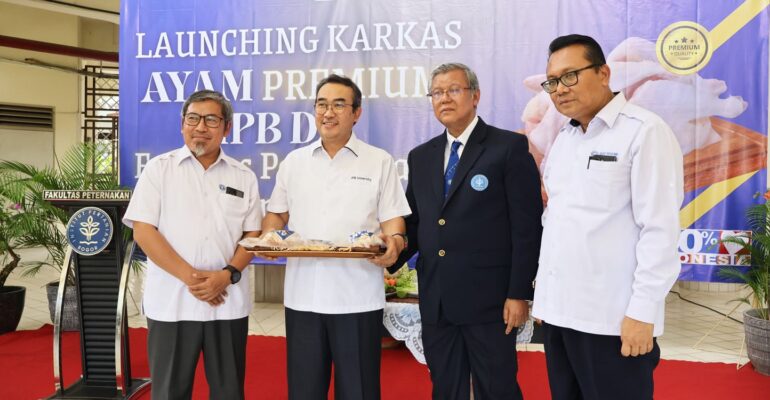
Dependence on imported protein sources remains a major challenge to national food security. The Faculty of Animal Science (Fapet) at IPB University has responded to this challenge with its IPB-D1 chicken carcass product.
“This IPB-D1 chicken product is the result of a very long research journey,” said the Dean of Fapet IPB University during his speech at the launch of the IPB-D1 Premium Local Broiler Chicken Carcass on Monday (12/15) at the IPB Dramaga Campus.
He recounted that since 2010, IPB University researcher Prof Cece Sumantri and his team have been conducting continuous development. Starting from the breeding system, maintenance system, feed formulation, to finally producing a superior chicken breed that is now ready for production and marketing.
“The superiority of IPB-D1 chickens lies not only in their productivity, both in terms of meat and eggs, but also in the quality of their products. These chickens have high protein and amino acid content, are rich in antioxidants, and contain important minerals such as magnesium, zinc, selenium, and manganese in relatively high levels,” Prof Idat continued.
With these characteristics, IPB-D1 chicken products not only serve as conventional food but also have the potential as functional food products to improve nutritional status and support specific health functions.
“And today, we are witnessing that this innovation has reached a very important stage, namely that it is ready to be utilized by the community and industry,” he said, concluding his speech.
Prof Cece Sumantri, as a researcher, outlined the characteristics of the IPB-D1 chicken. Genetically, the IPB-D1 chicken is the result of crossing an F1 male (Pelung × Sentul) with an F1 female (Kampung × Parent Stock Cobb broiler), with each gene composition being 25 percent.
The research and development of the IPB-D1 chicken involved a multidisciplinary team covering aspects of breeding, cultivation, feed nutrition, livestock health, meat quality, and product marketing and commercialization.
The team involved in this research consists of Prof Cece Sumantri and Dr Sri Darwati (Animal Breeding and Genetics); Prof Niken Ulupi and Dr Rudi Afnan (Cultivation Techniques); Prof Sumiati (Feed Nutrition); Dr drh Sri Murtini (Disease Resistance); Dr Lucia Cyrilla (Marketing and Commercialization); and Prof Irma Isnafia Arief, Dr Zakiah Wulandari, and Dr Wulan (Physical and Chemical Quality of Meat).
Through the launch of the IPB-D1 premium local broiler chicken carcass, the Faculty of Animal Science at IPB University reaffirms its commitment to delivering research-based innovations to support food security, public health, and sustainable national livestock development. (*/Rz) (IAAS/NVA).

