
IPB University Deploys Disaster Response Team, Introduces Innovation of 18.000 Ready-to-Eat Sterile Rice Packages
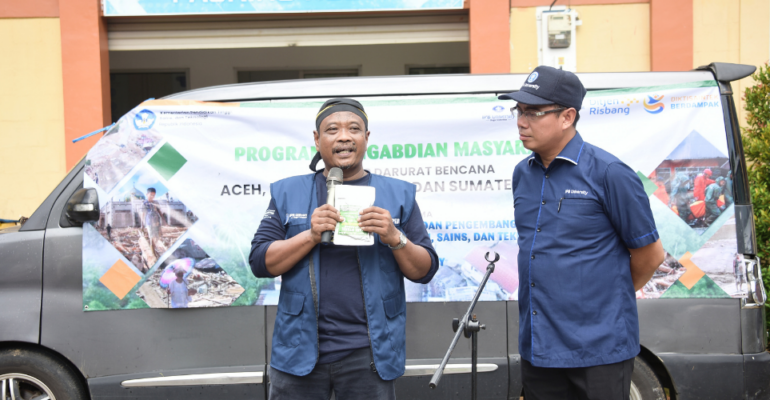
IPB University has once again reaffirmed its commitment to humanitarian action by deploying its Disaster Response Volunteer Team to three affected provinces, Aceh, North Sumatra, and West Sumatra. The team’s deployment aims to assist disaster affected communities while introducing an emergency food innovation in the form of practical and nutritious ready to eat sterile rice.
The volunteer team was officially dispatched from the Agribusiness and Technology Park (ATP) of IPB University in Bogor on Friday (12/20). The team consists of 18 lecturers and 25 students from various disciplines, coordinated by the Directorate of Agromaritime Community Development (DPMA) of IPB University.
The Rector of IPB University, Dr Alim Setiawan Slamet, emphasized that the involvement of higher education institutions in disaster management is part of their social responsibility, grounded in science and innovation.
“The deployment of IPB University’s Disaster Response Volunteer Team reflects our concern for communities affected by disasters in Sumatra. IPB is present not only to distribute aid, but also to offer sustainable, innovation based solutions,” he stated.
He further explained that this emergency disaster response community service program is the result of a collaboration between IPB University and the Directorate General of Research and Development of the Ministry of Research and Technology.
The program was designed comprehensively around four main pillars. The first pillar focuses on training and the provision of 18.000 packages of ready-to-eat sterile food to meet the nutritional needs of disaster-affected communities. This food product can be consumed directly without requiring clean water or heating, making it highly relevant in emergency situations.
“In disaster situations, access to clean water and cooking facilities is often limited. Therefore, ready to consume food innovations are critically important,” he explained.
The second pillar includes integrated health services, encompassing basic healthcare based on herbal and complementary approaches such as acupuncture and acupressure. In addition, telemedicine support is also provided, involving healthcare professionals as well as disaster rehabilitation cadres.
The third pillar is focused on the distribution of 13.500 special food packages for toddlers. This program aims to prevent malnutrition, improve nutritional intake, and maintain the health of vulnerable age groups during the emergency disaster response period.
Meanwhile, the fourth pillar is directed toward post-disaster psychosocial assistance. This support is expected to help restore the mental resilience of the community, reduce acute stress, and strengthen social stability in affected areas.
“Through these four pillars, IPB not only provides logistical assistance but also transfers knowledge to partner universities at the disaster response posts and to local volunteers. It is hoped that this program can be continued independently, ensuring the sustainability of innovation in disaster management,” he added.
The Director of Agromaritime Community Development at IPB University, Dr Handian Purwawangsa, added that the innovation of ready-to-eat sterile rice has become one of the leading solutions for emergency food management due to its practicality and long shelf life.
“This ready to eat sterile rice can be consumed directly without cooking or reheating, has a shelf life of up to two years, and its flavor is adapted to suit Indonesian tastes,” explained Dr Handian.
According to him, the raw materials for sterile rice are relatively easy to obtain, making the product highly replicable in various disaster-prone regions. The product is available in a range of menu variants, including nasi liwet, nasi kuning, kaffir lime chicken rice, nasi uduk, and fried rice. All variants are packaged in 150-200 gram pouches, equivalent to one adult meal portion, making them easy to mobilize and ready for on-site consumption.
The distribution of aid and technological innovation is carried out through collaboration with local partner universities serving as disaster response posts, namely Universitas Syiah Kuala (USK), Universitas Sumatera Utara (USU), and Universitas Andalas (Unand).
Through this collaboration, IPB University hopes to contribute not only to emergency disaster response efforts but also to strengthening the capacity of local institutions and communities, enabling them to become more prepared and resilient in facing future disasters. (AS)(IAAS/RWA)

