
IPB University Agrometeorology Expert: 2025 Sumatra Floods Provide Important Lessons on the Use of Climate Science
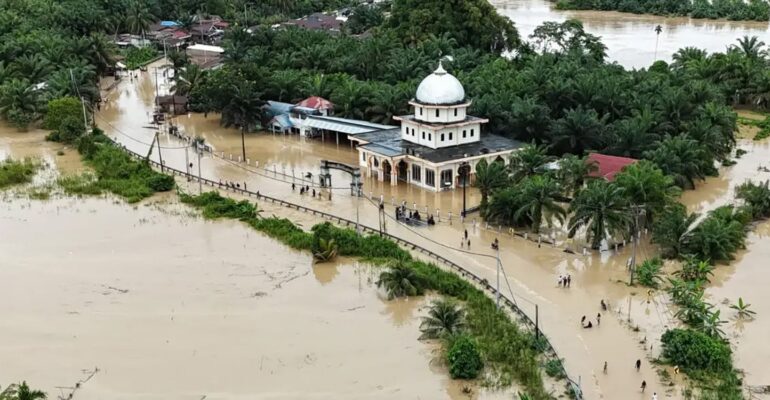
The floods and landslides that hit a number of areas in Sumatra in November 2025 provided important lessons on the urgency of using climate science in handling hydrometeorological disasters.
This was stated by Dr I Putu Santikayasa, an agrometeorology expert from the Department of Geophysics and Meteorology, Faculty of Mathematics and Natural Sciences, IPB University.
“This incident shows that climate information and analysis play a strategic role in reducing risk, improving preparedness, and strengthening community resilience in the face of disasters,” he explained during the LRI TALK #3 event themed “Together Protecting Sumatra: Collaboration in Mitigation, Law Enforcement, and Ecosystem Restoration to Face Hydrometeorological Disasters” (12/24).
In his presentation titled Climate Science in Hydrometeorological Disaster Management, Dr Putu began by highlighting stories of flood and landslide victims in Sumatra that were widely reported in the news and digital media. On November 25, 2025, more than 50 people were trapped in the middle of the forest for two days and two nights due to floods and landslides.
One resident from the upstream area testified, “Be careful, there has been a landslide from above. The landslide has been held back by trees.” This means that news of a landslide being held back on the hill had actually been circulating by word of mouth before the disaster escalated.
He explained that the climate conditions at the time of the incident were not entirely normal. “There were extreme climatic conditions during the Sumatra floods,” he said. According to him, climate variability in Indonesia is influenced by various phenomena, including the Asian and Australian monsoons, El Niño–Southern Oscillation (ENSO), Indian Ocean Dipole (IOD), tropical cyclones, and Madden–Julian Oscillation (MJO).
Based on his analysis, in the last ten days of November 2025, the IOD was in a weak negative phase and ENSO showed weak La Niña conditions that tended towards neutral. However, he considered that the most influential factor was the emergence of a tropical cyclone seedling in the Malacca Strait, which triggered extreme rainfall and exacerbated flooding in Sumatra.
“The BMKG (Meteorology, Climatology, and Geophysics Agency) recorded rainfall in northern Sumatra reaching more than 300 millimeters. In fact, on November 26, there was daily rainfall of around 438 millimeters, which is equivalent to one month’s rainfall in a single day,” he explained. These conditions increased the potential for widespread flash floods and landslides.
The Role of Climate Science
Furthermore, Dr Putu emphasized that climate science plays an important role in the entire disaster risk reduction cycle, from pre-disaster, during disaster, to post-disaster. In the pre-disaster phase, historical data analysis and extreme indices can be used to map vulnerable zones and improve preparedness.
During disasters, climate information supports the development of impact-based forecasting so that emergency responses can be carried out quickly and efficiently. Meanwhile, in the post-disaster phase, long-term climate projections are needed to support community recovery, reconstruction, and adaptation.
“The warning system gives us time to prepare, and adaptive infrastructure gives us the capacity to survive,” he concluded, emphasizing that the use of climate science is key to improving resilience to hydrometeorological disasters in the future. (Fj) (IAAS/LAN)

