IPB University Academics: Ethics and Empathy are Key to Public Communication in the Attention Economy Era
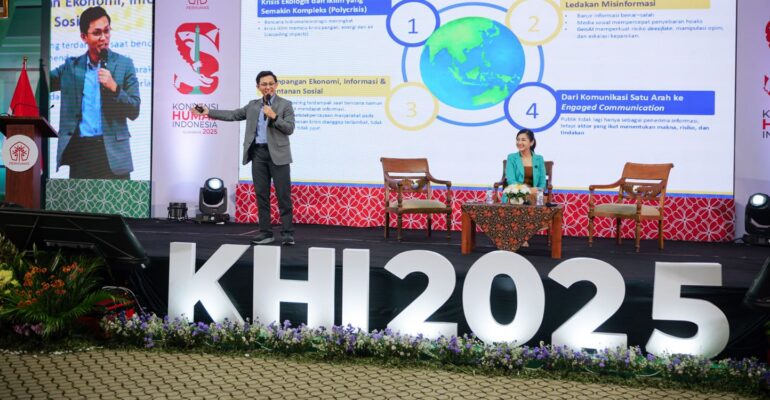
As the flow of information becomes increasingly rapid and the public sphere becomes increasingly noisy, ethics and empathy are key to public communication. This assertion was made by the Director of Cooperation, Communication, and Marketing at IPB University, Dr Alfian Helmi.
In the attention economy era, messages, opinions, and narratives from various directions compete for attention. The flood of information often obscures the substance of the message and erodes public trust. This condition, said Dr Helmi, requires fundamental changes in the way institutions and public officials communicate with the community.
“It’s not just what is said, but how the message is conveyed with empathy, honesty, and a commitment to the public interest,” said the lecturer from the Department of Communication Sciences and Community Development at IPB University while attending the 2025 Indonesian Public Relations Convention (KHI) in Surabaya (12/14).
He emphasized that changes in the media landscape mean that public communication is no longer effective if it is one-way. The public’s increasingly short attention span, increasingly emotional consumption of information, and high competition for messages in the digital space demand a more human and relevant approach to communication.
For example, statements made by a number of public officials in response to various recent disasters have been criticized for being lacking in empathy and overly administrative. According to him, failing to understand the perspective of the affected community can trigger a greater crisis of trust.
“In the context of disasters, communication cannot be viewed solely from the government’s perspective. What has been done or how much budget has been spent. What is more important is the perspective of the victims, whether they have been helped and what the real impact is on the community,” said Alfian.
He emphasized that empathy must be the first message in any crisis communication. Without empathy, even the best message will lose its meaning. Therefore, he believes that there needs to be two layers of communication that run in parallel, namely risk communication before problems arise and crisis communication after the event.
“The two must complement each other so that public communication does not become a source of new problems,” he said.
In this context, he considers it important to update the Code of Ethics of the Indonesian Public Relations Association (Perhumas), which was formalized in KHI 2025.
He believes that this code of ethics can serve as a moral compass for public relations professionals in facing increasingly complex communication challenges, ranging from disaster crises and public health issues to digital media disruption.
“This code of ethics is important because it embodies the principles of truth, transparency, accuracy, responsibility, and commitment to the public interest. In the future, these ethical standards are expected to become a national reference and be widely applied in the professional world of public relations,” he emphasized. (dr) (IAAS/Ard)