Indonesia Surrounded by Three Cyclone Systems, IPB University Lecturer Reveals Cause of Extreme Flooding in Sumatra
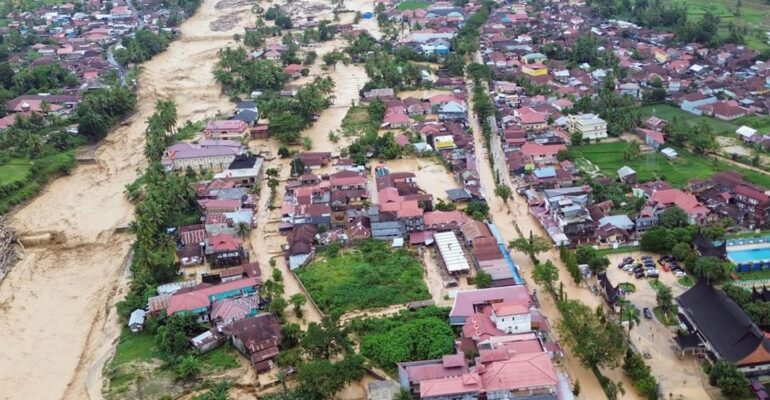
Extreme weather phenomena are once again testing the resilience of the Indonesian people. In recent days, severe flooding has hit a number of areas in Sumatra.
According to an analysis by Sonni Setiawan, SS, MSi, a lecturer at the Department of Geophysics and Meteorology at IPB University, recent weather conditions have been unusual. He said that the phenomenon occurring in Sumatra was triggered by a tropical cyclone that formed very close to the equator, a rare occurrence.
“This year has attracted the attention of meteorologists because the tropical cyclone occurred near the equator, even below 5 degrees latitude,” he said.
This phenomenon is known as Tropical Cyclone Senyar, whose interaction is amplified by several other atmospheric systems.
“There is an interesting interaction between Tropical Cyclone Senyar, the Equatorial Rossby wave, the Madden Julian Oscillation (MJO) which is in phase 6 in the tropical Western Pacific, the IOD, and the intense La Niña due to modulated sunspot activity,” explained Sonni.
La Niña and the IOD, characterized by warming sea surface temperatures, can provide an abundant supply of water vapor. This is a prerequisite for the formation of low pressure, which can then develop into tropical cyclone seeds and eventually grow into tropical cyclones. The presence of Equatorial Rossby waves and the MJO can strengthen convergence in the tropical cyclone genesis phase.
This combination, he continued, then formed large numbers of cumulonimbus clouds and triggered prolonged extreme rainfall in Sumatra. The rain can last for more than 24 hours.
At the same time, Indonesia is also under the influence of two cyclone seeds and Tropical Cyclone Fina, increasing the risk of hydrometeorological disasters.
“Tropical cyclones are synoptic-scale atmospheric disturbances that can trigger hydrometeorological disasters in the areas they pass through, especially on a daily basis in tropical regions,” he explained.
Under normal conditions, the formation of tropical cyclones follows the movement of the sun.
When the sun is in the Northern Hemisphere (NH), tropical cyclones occur more frequently in the north. When it shifts to the south, they are more prevalent in the south.
“However, this year an anomaly has emerged because the formation is occurring very close to the equator,” Sonny explained.
He also reminded that even though Indonesia is not the main path of cyclones, the impact is still significant. “The impact is not as great as in areas outside the latitude, but the potential for extreme rain and strong winds still needs to be watched out for,” he concluded.
This phenomenon of tropical cyclones near the equator is an important note for Indonesian meteorological science. Satellite monitoring and further in-depth studies are needed so that the public can be better prepared to face extreme weather that is increasingly frequent in the context of global climate change. (AS) (IAAS/KQA)