Facing Extreme Weather, IPB University Improves Tree Risk Management on Campus
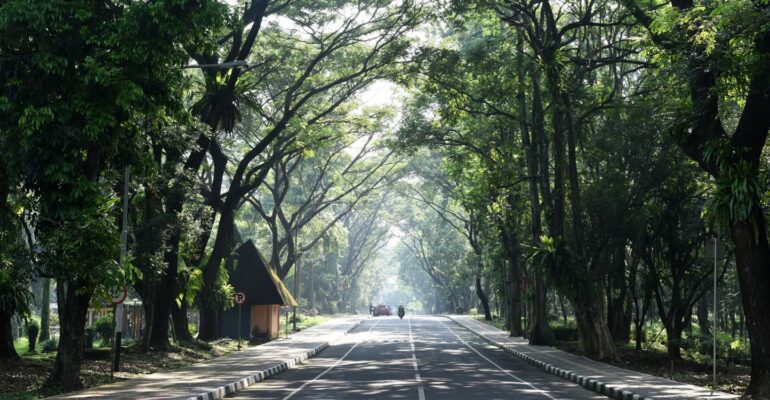
The increasingly frequent occurrence of extreme weather demands greater preparedness. As a campus dominated by green open spaces (RTH), IPB University is strengthening its mitigation efforts through the Tree Risk Management activities on Campus held at the Dramaga Campus.
A genetics and tree breeding expert from the Faculty of Forestry and Environment (Fahutan) at IPB University, Prof Iskandar Z Siregar, explained that trees are an integral part of residential areas and campuses. Therefore, their safety aspect needs to receive serious attention, equal to that of buildings.
According to him, this activity is designed to strengthen the capacity of field officers so they can quickly detect potential risks, both to human safety and to property such as vehicles.
“In extreme weather conditions like now, officers must understand the risks and be able to provide early warnings so that undesirable incidents can be prevented from the start,” said the individual who currently serves as Vice Rector for Global Connectivity, Cooperation, and Alumni at IPB University.
Meanwhile, the Director of General Affairs and Infrastructure at IPB University, Ahmad Kosasih, SE, said that mitigating the risk of falling trees is crucial considering the area of IPB Dramaga Campus, which reaches 267 hectares and is dominated by green open spaces.
“IPB has many large trees, especially along main roads such as Jalan Ramin. In this area, the risk of falling branches or trees is quite high, so mitigation must be carried out seriously and in a planned manner,” he explained.
As a concrete step, IPB University has implemented risk mapping through a zoning system, namely red, yellow, and green zones. The red zone, for example, is designated along Jalan Ramin, which is lined with large trees on both sides of the road.
This mitigation effort is carried out through cross-unit collaboration, involving the Risk Management Office, the Faculty of Forestry and Environment, and students as part of learning and community service.
Prof Efi Yuliati Yovi, Vice Manager of the Forestry and Environmental Information and Innovation Center (PI2KL), emphasized the importance of a comprehensive and balanced risk management approach.
“Tree mitigation must be seen from two perspectives, namely tree conservation needs and human needs. Both cannot be separated,” she said.
According to her, trees have very important ecological functions, ranging from providing wildlife habitats, supporting hydrological systems, to sustaining biodiversity. However, on the other hand, the campus is a space for human activities that demands safety assurances.
“Therefore, comprehensive risk management is required, starting from zoning based on activities, tree inventory, to mapping the potential hazards of each tree. From there, the most appropriate mitigation strategies can be determined,” she explained.
She emphasized that conservation remains the main principle of IPB University, but safety for the academic community and campus visitors must not be overlooked.
“The campus is a space for education and human activities. Conservation is important, but safety must also be maintained. This is where the balance must be built,” she concluded. (AS) (IAAS/KMR)