
Asia Threatened by Food Crisis due to Depopulation: IPB and Kyoto University Call for Collaboration
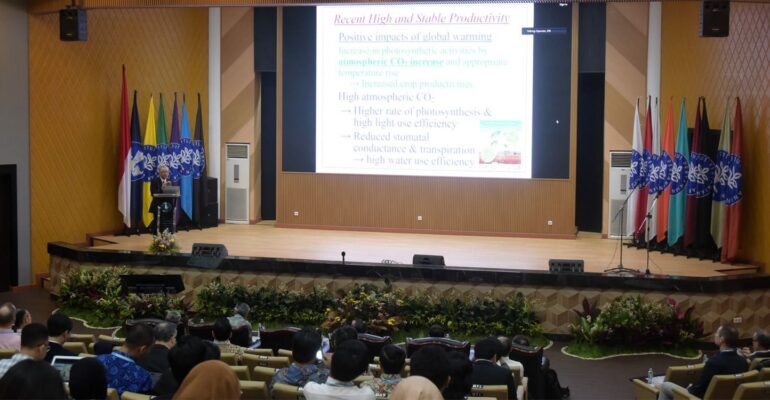
Asia faces a new threat. The accelerating aging of the population has the potential to disrupt the agricultural sector, which is the backbone of food production. This issue was the main focus of academics and researchers attending the 2025 Kyoto University International Symposium at IPB University, Bogor.
In his presentation, Prof Izuru Saizen, Vice Dean of the Graduate School of Global Environmental Studies (GSGES) at Kyoto University, presented his research findings that countries in the Southeast Asian region are experiencing a decline in birth rates and an increase in the number of elderly people.
“Without adequate preparation, there are concerns about a slowdown in economic growth and an increase in the fiscal burden,” he said.
Take Thailand, for example. Its population pyramid is now shaped like a “bottle” due to the decline in the young population. In Vietnam, the population aged 65 and above has reached 8,6 percent and is projected to continue to double.
What about Indonesia? The trend is similar. The total fertility rate (TFR) continues to decline. In 2024, Indonesia’s TFR was recorded at 2,11. Following Japan, Singapore, Thailand, Malaysia, and Brunei, it has long been below 2,1.
“We need to conduct collaborative research across countries to prepare for an unprecedented era of population decline. The sustainability of agriculture in rural areas is very important because these areas are the centers of food production in all Asian countries,” he explained.
Kyoto University ASEAN Center representative Prof Eiji Nawata presented the development of rice production in Southeast Asia over the last four decades. The highest increase in production was recorded in Thailand (17%), followed by Cambodia (6,3%), Laos (3,5%), Vietnam (3%), the Philippines (2,7%), Indonesia (1,5%), and Malaysia (1,2%).
He also highlighted key issues for future agricultural science, such as technical adaptation to global warming, variety development, new agricultural systems, energy-efficient technology, molecular biology and microbiology, artificial intelligence (AI)-based smart agriculture, rural development, and sustainable global environmental improvement.
Meanwhile, IPB University Vice Rector for Research, Innovation, and Agromaritime Development, Prof Ernan Rustiadi, welcomed the delegations from each country by introducing various innovations, facilities, and programs at IPB University that support sustainable development.
“IPB University serves as a model for the integration of education, research, and innovation that is relevant to sustainable development,” he explained.
The collaboration with Kyoto University has been ongoing for a long time. Going forward, he is committed to expanding the collaboration, including strengthening joint research and developing double degree programs.
This symposium is expected to strengthen the Asian research network and open up new opportunities for collaboration to address future demographic and agricultural challenges. (dh) (IAAS/KQA)

