
Advancing Indonesia as a Global Halal Hub, IPB University Expert Emphasizes Strengthening Science and Innovation
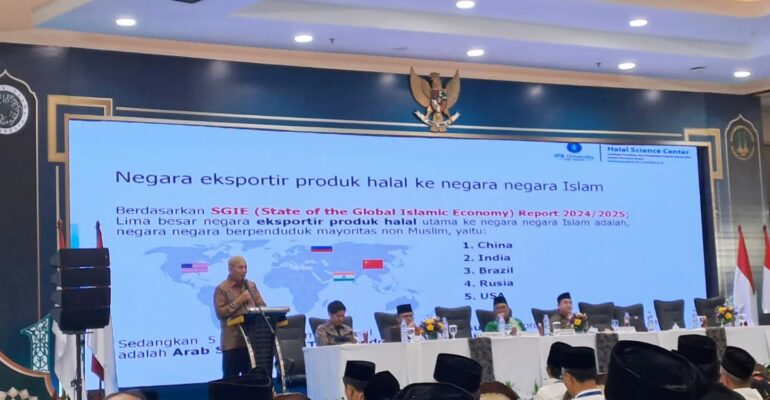
IPB University underscores the importance of strengthening research and innovation to support Indonesia’s ambition of becoming the global halal hub. This was conveyed by Prof Khaswar Syamsu, Professor at IPB University and Chairman of the Halal Science Center (HSC), in response to the continued growth of the global halal industry.
During the 11th National Conference of the Indonesian Ulema Council (MUI) held recently, Prof Khaswar highlighted that global Muslim consumer spending reached USD 2,43 trillion in 2024. This figure is projected to rise to USD 3,36 trillion by 2028.
However, he emphasized that Indonesia has not yet achieved the leading position. Indonesia currently ranks third in the Global Islamic Economy indicator, and in the halal food sector, it has dropped to fourth place.
“A large Muslim population does not automatically position Indonesia as the leader of the halal industry. We need strong support from science, innovation, and a robust Halal Product Assurance System (SJPH). Otherwise, Indonesia risks remaining the world’s largest market and consumer of halal products, instead of becoming a major producer,” he stated.
Prof Khaswar stressed that strengthening the halal ecosystem requires science and innovation across multiple aspects. From enhancing production efficiency and researching halal alternative ingredients, to digitalization and traceability, detection of non-halal materials, and research and development (R&D) collaboration with industry.
This perspective aligns with the statement from IPB University Rector, Prof Arif Satria. Prof Arif pointed out Indonesia’s challenges in the Global Innovation Index (GII), particularly in weakened innovation input in 2025.
“Indonesia’s GII ranking dropped by one position in 2025 due to a decline in innovation input. However, compared to 2021, we have made significant progress. Our innovation output continues to improve, government and private sector research spending is increasing, and the number of patents from Indonesia has risen sharply,” he explained.
Prof Arif, who also serves as Chairman of the Indonesian Muslim Intellectuals Association (ICMI), noted that these achievements signal Indonesia’s readiness to enter an innovation-driven economy. He added that Indonesia needs a solid research ecosystem, including strong research infrastructure, competent human resources, sustainable funding, and an integrated national research agenda.
“Research must be the driving force of national development. We are preparing a national research agenda aligned with the Sustainable Development Goals (SDGs), spanning food, energy, health, and knowledge-based economy,” he affirmed.
The combination of strengthening halal research and consolidating the national innovation ecosystem is viewed as a crucial foundation for Indonesia’s transformation from a halal market into a global halal producer. This synergy represents a strategic step toward realizing Indonesia as the global halal hub. (Am) (IAAS/MRM)

