
Young Professor at IPB University Wins Habibie Prize 2025
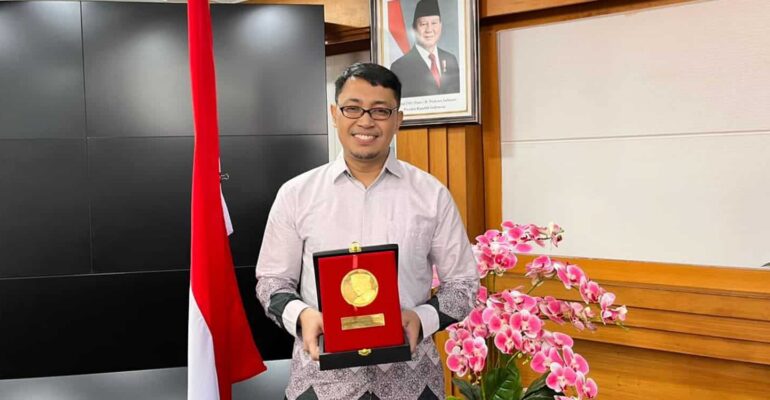
Professor Anuraga Jayanegara (42 years), a professor at the Faculty of Animal Science at IPB University, won the Habibie Prize 2025, a prestigious award given to Indonesian scientists for their outstanding contributions to the development of science and technology.
This young professor admitted that he did not expect his name to be announced as the recipient of the award, which is often referred to as the “Indonesian Nobel Prize.”
“I myself did not know the process. Suddenly, I was contacted and told that I had won the Habibie Prize. At first, I thought it was a hoax,” he said with a smile.
The Habibie Prize 2025 is a collaboration between the Habibie Center and the National Research and Innovation Agency (BRIN) with funding support from the Education Fund Management Institution (LPDP).
The selection and assessment process involved various national and international institutions, including researchers from abroad.
“I also don’t know what the indicators are, but maybe it’s because my research has been ongoing since my master’s degree until now. Maybe that’s what they recognized,” said the figure who currently serves as Director of Strategic Studies and Academic Reputation at IPB University.
Prof Anuraga explained that his research has focused on feed science and technology, particularly feed engineering for livestock to reduce greenhouse gas (GRK) emissions. He has been pursuing this topic since his studies in Germany and Switzerland, and has continued to develop it for more than 15 years.
“We engineer feed so that livestock remain productive but produce lower methane emissions. So, the contribution is not only for the livestock sector but also for climate change mitigation,” he explained.
In his research, Prof Anuraga makes extensive use of natural compounds from plants, such as polyphenols and tannins—components also found in tea and known to have health benefits.
“The astringent component in tea is tannin. Well, it is this active compound that we utilize in livestock feed to reduce methane emissions,” he added.
For him, IPB University provides tremendous support through a conducive research ecosystem. “IPB is very supportive, especially in terms of the environment and facilitation. The team works like man-to-man marking, accompanying lecturers from proposal submission to grant acquisition,” he said. (AS) (IAAS/KDP)

