Synergy Between PKSPL IPB University and PT Amman Mineral for Sea Turtle Conservation in Gili Balu
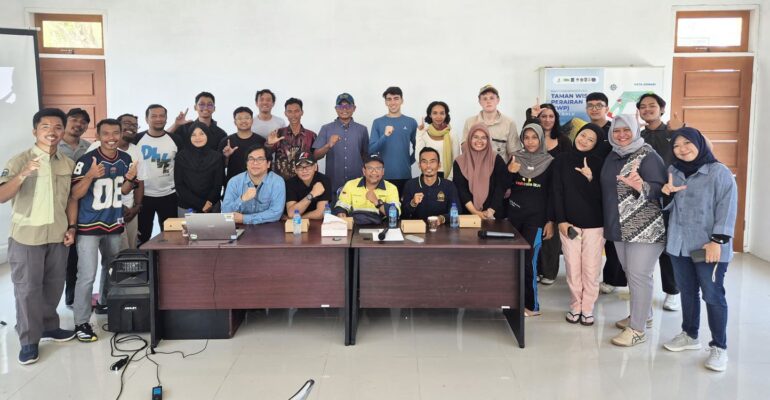
The Center for Coastal and Marine Resources Studies (PKSPL) of IPB University is committed to protecting sea turtle populations in the Gili Balu area, West Sumbawa. One of its initiatives includes a collaboration with PT Amman Mineral Nusa Tenggara to conduct technical training for local communities.
The activity involved members of the Community Monitoring Group (Pokmaswas), Tourism Awareness Group (Pokdarwis), and representatives from the Regional Public Service Agency (BLUD).
“This training strengthens community understanding of the importance of sea turtle protection as part of coastal ecosystem balance,” said Andy Afandy, Vice Chief of PKSPL for Natural Resource and Environmental Management Programs.
He added, “We also encourage communities to take an active role in protecting turtle nesting and landing areas from disturbances and environmental changes.”
A representative from PT Amman Mineral Nusa Tenggara reaffirmed the company’s commitment to supporting marine conservation and community empowerment programs through partnerships with academic institutions and local communities. The company believes that environmental sustainability and coastal community welfare must go hand in hand.
“Our support for this activity is part of the company’s social responsibility to protect marine ecosystems that serve as shared sources of life,” said the PT Amman Mineral representative.
In addition to technical training, the program also included coral reef transplantation module installation and mangrove seed planting along the Poto Tano coastline. The activities were carried out in collaboration with local communities, PKSPL IPB University experts, students from Universitas Negeri Surabaya (Unesa) and Universitas Mataram (Unram), as well as five internship participants from Canada who actively took part in the fieldwork.
This cross-institutional and international collaboration reflects that efforts to ensure marine sustainability are a shared global responsibility.
One of the Canadian interns, Justin, a Sociology and Criminology graduate, shared his impressions of the program, which integrates conservation with coastal community empowerment.
“The community empowerment program by PKSPL IPB and PT Amman is a strong initiative that connects conservation efforts with improving local livelihoods,” he said.
For Justin, the program is practical and provides opportunities for communities to protect the environment while supporting their families. “From the sea turtle training, I learned how collaboration and shared responsibility can strengthen partnerships and make conservation efforts more effective,” he expressed.
During the program, PKSPL IPB University also conducted an Impact Assessment and Outcome Harvesting to evaluate the achievements and the social and ecological impacts of the conservation initiatives in the area. The evaluation results are expected to serve as a foundation for improving future conservation and community empowerment strategies.
Sea turtle conservation and coastal rehabilitation have the potential to open new economic opportunities through conservation-based marine tourism and sustainable, resource-driven local economic development.
Through the synergy among communities, academia, the private sector, and international partners, this initiative demonstrates that environmental protection and community welfare can progress hand in hand making Poto Tano a real example of sustainable coastal development in Indonesia. (*/Rz) (MRM)