IPB University Rector: Young Generation is Key to Indonesia’s Future Food Security
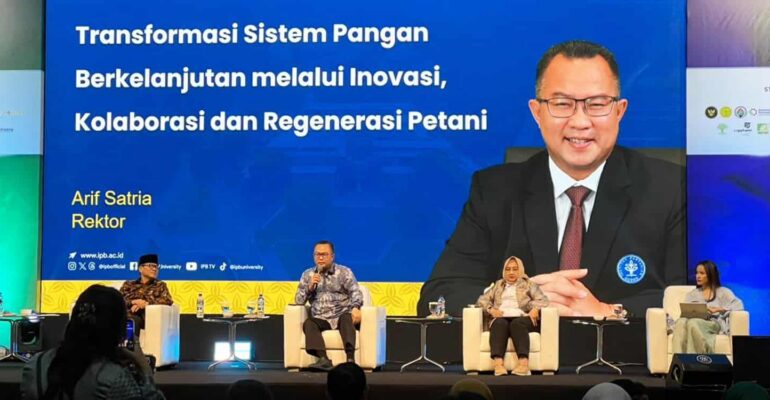
IPB University Rector Prof Arif Satria was a guest speaker at the Nusantara Livestock and Poultry Expo, which was held alongside the Indonesia Agriculture Technology (IndoGriTech) Expo 2025, at ICE BSD, Thursday (11/6). On this occasion, he delivered a presentation on “Transforming Sustainable Food Systems through Innovation, Collaboration, and Farmer Regeneration.”
During the event, Prof Arif also held discussions with the Minister of Villages, Disadvantaged Regions, and Transmigration, Yandri Susanto, and toured the exhibition with the Deputy Minister of Agriculture, Sudaryono.
Prof Arif explained that Indonesian President Prabowo Subianto has a strong commitment to strengthening the food sector. Therefore, this commitment needs to be complemented by innovation and strong human capital.
“We hope that many young people will enter the fields of agriculture, fisheries, and animal husbandry. Because this will be the future of Indonesia’s economic strength,” said Prof Arif.
In addition, he continued, IPB University also continues to produce superior innovations to support its commitment to strengthening the food sector. He mentioned that there are 145 superior varieties in the food sector that are beneficial for agricultural development throughout Indonesia.
“What IPB is doing today is so that we can continue to produce superior innovations. We already have various rice varieties. There are 15 rice varieties, but there are also 145 other plant varieties. These can be utilized for agricultural development,” he explained.
In addition, Prof Arif said that IPB University also has a One Village One CEO (OVOC) program that has been developed in 1.043 villages throughout Indonesia. This program encourages IPB University students and alumni to become sociopreneurs and be present in these villages by disseminating innovations, opening up market and financial access, and encouraging villages to become export villages.
Currently, Prof Arif said, many students have become exporters and many villages have become export villages. This reflects the commitment of today’s youth who dare to venture into the agricultural sector, not only to feed Indonesia but also to feed the world.
“I think this is a great achievement and I hope it can spread to various groups and other regions, so that this ecosystem can continue to be developed with support from the government, the private sector, farmers, and the wider community,” he said. (*/Rz)(IAAS/RWA)