Biocoagreen: Used Cooking Oil Solidifier from Sugarcane Bagasse Waste Discovered by IPB University Students
IPB University students have once again demonstrated their pioneering spirit in sustainable innovation. Through the Student Creativity Program in Entrepreneurship (PKM-K), the Biocoagreen team successfully converted used cooking oil waste into safe solid waste by utilizing sugarcane bagasse waste, as a concrete step toward achieving the zero-waste concept.
Starting from concerns about used cooking oil waste that is often disposed of carelessly and pollutes the environment, this team presented a simple yet impactful solution. They converted used cooking oil into safe solid waste by utilizing sugarcane bagasse waste from local micro, small, and medium enterprises (MSMEs).
The Biocoagreen team is led by Marsha Callista Birachmatika, with members Riswan Yanuar Gani, Elramda Nafis, As Syifa Savitri, and Keiko Eventius Warman. This cross-disciplinary collaboration is the main strength in developing innovative products that are economically and environmentally sustainable.
“The idea for Biocoagreen was inspired by a popular used cooking oil solidifier product in Japan. However, instead of using synthetic materials, our team adapted the concept to the Indonesian context with a circular economy approach,” said Marsha.
Biocoagreen utilizes sugarcane bagasse, a waste product often generated by sugarcane juice vendors, as the main ingredient in the manufacture of oil solidifiers. Marsha stated, “This innovation not only addresses oil waste, but also adds value to other organic waste that is abundant around us.”
Through a series of formulation tests, the team successfully created a sugarcane bagasse-based oil solidifier product. This innovation helps reduce hazardous liquid waste from used cooking oil and promotes the implementation of a circular economy: one type of waste is converted into another useful product.
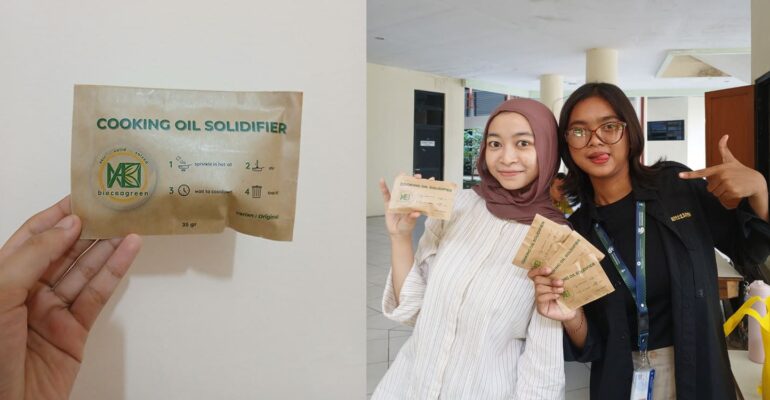
The Biocoagreen product, Marsha continued, is packaged in a bundle containing two sachets in original and charcoal variants. Each sachet can solidify 100–150 mL of used cooking oil, which can then be disposed of with organic waste without polluting the environment.
“In terms of price, Biocoagreen has a competitive advantage. One bundle is priced at only Rp7.000 for 36 grams of product, which is much more affordable than similar products on the market that cost up to Rp13.000 per sachet,” she said.
Furthermore, the solid oil residue from this product is currently being researched for development as an additional fat source for animal feed, opening up opportunities for diversifying the benefits of the same innovation.
Currently, Biocoagreen is marketed in the Greater Jakarta area, with the majority of customers being housewives who care about kitchen and environmental hygiene. The positive response from the community shows that awareness of household waste management is increasing.
“Through Biocoagreen, we are not only demonstrating our research and innovation capabilities, but also bringing the spirit of sustainability into people’s daily lives,” said Marsha. (dr)(IAAS/RWA)