
Uncovering the Secrets of Charming Odd-Eyed Cats
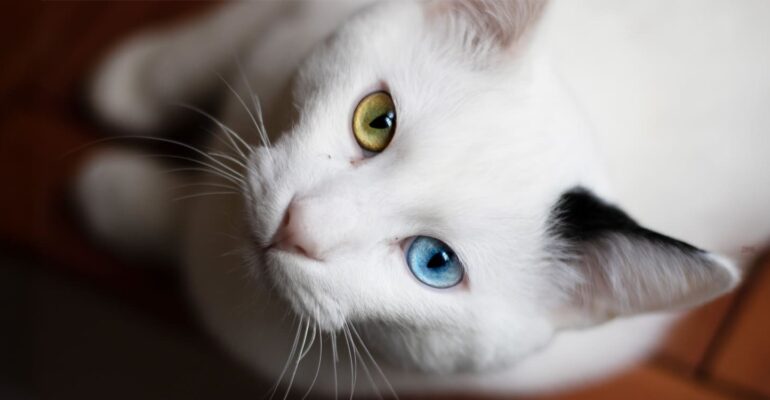
Perhaps some of us have encountered and seen cats with different colored eyes between their left and right eyes. The contrasting eye color with their generally white bodies makes these cats look so charming.
In the cat world, this difference in eye color is known as odd eyes or heterochromia. This eye color anomaly is commonly found in white cats, though it occasionally appears in cats of other colors.
Why do cats have different eye colors?
A cat’s eyes are truly fascinating. Compared to the size of its head, its eyes are remarkably large. Naturally, a cat’s eyes have evolved to adapt exceptionally well to the darkness of night. In the wild, cats actually belong to the category of nocturnal animals.
For cat lovers, eye color is one of the considerations for keeping or breeding them. This diversity of colors is certainly captivating. Cat eye colors range from blue, green, yellow, to brown.
Eye color is controlled by genes and is therefore hereditary. Therefore, through selective breeding, we can produce cats with the desired eye color.
For example, Siamese cats have blue eyes as the standard for the purity of this breed. Similarly, cats with other color variations can be produced through selective breeding programs.
The colored part of a cat’s eye is called the iris. Eye color is formed due to the presence of pigments produced by melanocytes in the iris. The intensity and color produced depend heavily on the number and activity of the melanocytes.
If there are no melanocytes in the iris, the cat’s eyes will be blue. When melanocyte levels are low, the eyes will be greenish. Conversely, when melanocyte levels are high, the eyes will be copper or brown.
The color of a cat’s eyes is also determined by the intensity of the melanocytes in the iris. If the intensity is low, the cat’s eye color will be brighter, while if the intensity is high, the cat’s eye color will be darker.
The activity of melanocytes that determine a cat’s eye color is controlled by multiple genes (polygenes) located on different chromosomes. This is what allows cat breeders to produce cats with specific eye colors through selective breeding programs.
How do odd eyes occur?
Cats with odd eyes can occur due to genetic factors or other causes such as illness, medication, or other factors. The most common cause is an abnormality that occurs during embryonic development.
Under normal circumstances, stem cells migrate to various parts of the body depending on the type of cell that will form a specific tissue. During embryonic development, some of these stem cells stop migrating in the eyes and subsequently develop into melanocytes.
In certain circumstances, melanocytes may be blocked in one eye. As a result, that eye has pigmentation and produces green, brown, or mixed eye colors. However, the other eye will be blue because there are no melanocytes.
The blue color in odd eyes is caused by the absence of melanocytes, while the color of the other eye depends on the level of melanocytes produced in the iris. Odd eyes in cats generally occur in pure white cats or cats with white spots.
The appearance of white color in cats is controlled by a dominant gene. The presence of the dominant white gene and white spots will interfere with the migration of melanocytes to the eyes during embryonic development.
Another thing to note when keeping white cats is deafness. This can occur because the gene that controls the appearance of white color is generally associated with deafness in cats.
Deafness generally occurs in pure white cats with blue eyes or odd eyes. Odd eyes also occur in humans with a mechanism similar to that in cats.
Odd eyes in the cat world are indeed an intriguing phenomenon, as they produce unique and captivating cats.
By: Prof Ronny Rachman Noor
Professor of Genetics and Animal Breeding
Faculty of Animal Science, IPB

