Rector of IPB University Becomes Keynote Speaker at the ASEAN-China Center Conference in Henan, China
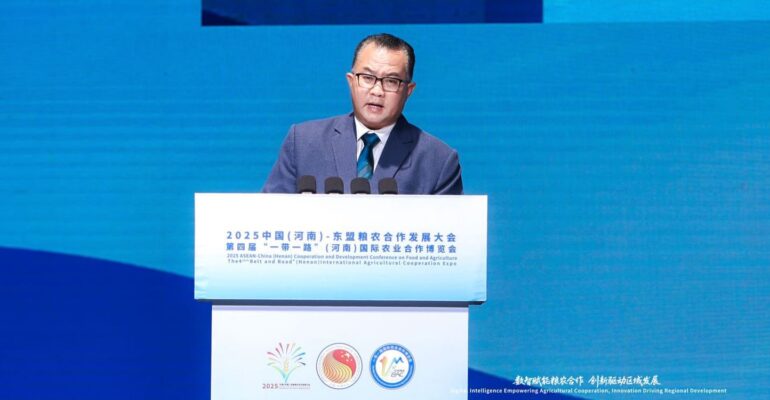
Rector of IPB University Prof Arif Satria served as a keynote speaker at the 2025 ASEAN-China Cooperation and Development Conference on Food and Agriculture, held in Zhengzhou, Henan, China (10/13). The event, opened by the Vice Minister of Agriculture and Rural Affairs of China, was organized by the ASEAN-China Center based in Beijing.
On this occasion, Prof Arif delivered a speech on a shared vision regarding the strengthening of technological innovation in agricultural and food cooperation that unites Southeast Asia/ASEAN and China.
Prof Arif explained that both China and ASEAN have strong dependence on the agricultural sector, particularly food. Both also face similar challenges such as climate change, the declining number of young farmers, and supply chain disruptions.
Therefore, according to him, cooperation between China and ASEAN is a necessity. He emphasized that innovation-based collaboration can address shared needs while bringing benefits to both parties.
“China’s innovation and ASEAN’s opportunities together have the potential to create a resilient and sustainable future in the food sector. Through cooperation in science and technology, we are not only strengthening trade, we are also securing livelihoods, protecting our environment, and nurturing the next generation,” said Prof Arif in his speech.
He also highlighted that ASEAN-China cooperation already has a strong foundation through the ASEAN Plan of Action on Science, Technology, and Innovation (APASTI), as well as various joint initiatives such as the ASEAN-China Summit and the ASEAN-China Year of Food Security.
Going forward, he encouraged the strengthening of joint research, the development of regional innovation incubators, the mobility of young scientists, and the acceleration of innovation downstreaming to industry.
“In the future, we need to deepen this ecosystem by strengthening joint research, building regional innovation incubators, promoting the mobility of young scientists, and opening innovation policies for technology sharing. This collaboration is not merely about sharing technology, but also about building capacity, strengthening mutual trust, and ensuring collective resilience in the region,” he said.
Prof Arif also acknowledged that China’s agricultural technology is advancing rapidly, strengthened by its remarkable mastery of artificial intelligence.
In addition, Prof Arif emphasized the important role of universities and research institutions as drivers of innovation and talent development. Through collaborative research and cross-sector partnerships, they strengthen the innovation ecosystem. In Indonesia, universities are also actively expanding higher education networks at the ASEAN, Asian, and global levels.
“Especially for IPB University, which plays an important role in the UC–SEARCA Consortium, works closely with the Asia Hub Consortium, and serves as Chair of the Governing Board of The Southeast Asian Regional Centre for Tropical Biology (SEAMEO BIOTROP). Bilaterally, IPB University has established partnerships with key institutions in China focusing on academic exchange, joint research, and student mobility programs,” he explained. (*/Rz)(IAAS/RSL)