
People with Mental Disorders Gain Basic Life Skills from IPB University Students
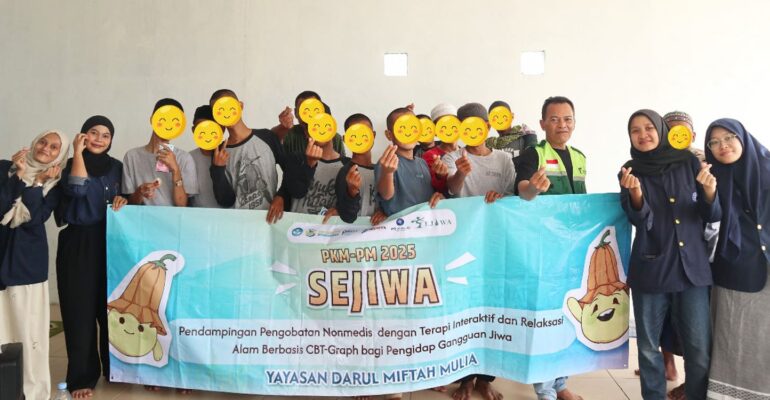
A total of 80 people with mental disorders gained basic life skills from IPB University students.
The students involved are Dhiya Sabilaah (Biochemistry), Hanawuri Nahari Johar and Farhana Ginanti Maharani (Mathematics), Marjan Kirana (Landscape Architecture), and Nabila Zahra. This initiative, named “Sejiwa,” is part of the Student Creativity Program (PKM).
The program involves non-medical treatment through interactive therapy and nature relaxation. The team uses the CBT-Graph method, which combines cognitive behavioral therapy, ecotherapy, and gamification.
Dhiya Sabilaah said that this program was initiated due to their concern about the negative stigma and treatment of people with mental disorders, which is often considered inhumane. Therefore, this program is designed to train psychomotor skills, equip them with basic life skills, and improve emotional expression and social interaction, so that they can return to living like normal people.
In its implementation, the team collaborated with Darul Miftah Mulia Bogor as a partner. This nonprofit foundation, established in 2004, is located in Kampung Cisuuk, Cibeuteung Udik Village, Ciseeng District, Bogor Regency, West Java.
This foundation occupies an area of 1.000 m2 with a building area of 700 m2. Five assistants from Darul Miftah Mulia Bogor handle 80 ODGJ, most of whom are productive men.
The program consists of six series with four main activities, namely Unting Souls (program introduction, socialization, administrator training, and participant pretest), Teka Hati (educational-interactive card games), Semaian Akar (planting activities, especially mint plants), Sentuhan Harapan (making mint-based aromatherapy pillows), and Suara Batin (self-reflection through stories, life trees, and wall magazines).
The program results showed that the participants were able to perform the activities given. They were able to coordinate their muscle and body movements with mental functions such as responding to activities, interacting, and thinking.
“We also observed that the participants took the initiative to do the activities. They were able to express themselves and participate in group activities as a form of social interaction, and they became more confident,” said Dhiya.
She and her team hope this program can be continued and serve as inspiration for similar foundations and communities. “We hope other foundations or communities can adopt this program as one of the non-medical treatments that can aid in mental health recovery,” she added. (dh) (IAAS/NRA)

