
Meteor in Cirebon Serves as a Warning: IPB University Physicist Discusses Real Threats from Outer Space
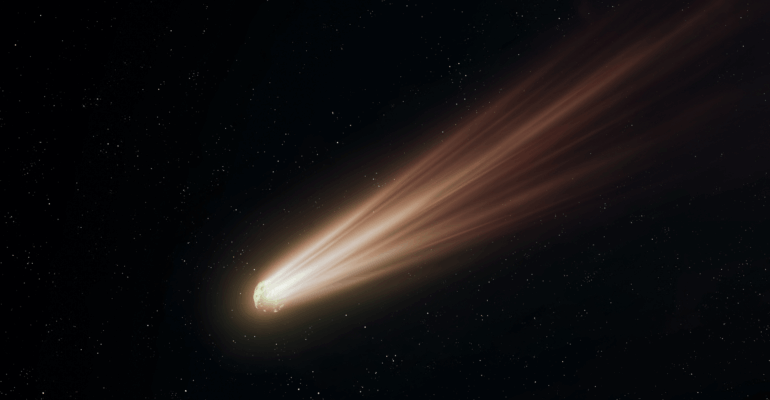
Earth, as the home of all life, is not entirely safe from threats coming from outer space. The recent meteor fall in Cirebon, West Java, serves as a real reminder that dangers from beyond our planet can occur at any time.
According to Prof Husin Alatas, a Professor of Theoretical Physics at IPB University, the incident illustrates that outer space is not as empty and peaceful as many imagine. It holds potential dangers that could threaten life on Earth.
“Outer space is filled with objects moving at very high speeds. When one of them leaves its stable orbit and is then pulled by Earth’s gravity, the potential for a collision becomes real,” said Prof Husin.
He added that the meteor in Cirebon likely originated from an asteroid located between the orbits of Jupiter and Mars, which then entered Earth’s atmosphere due to gravitational attraction.
One of the greatest threats, he continued, comes from asteroid and comet impacts. History records an event 66 million years ago on the Yucatán Peninsula, Mexico, when a massive asteroid strike caused the extinction of the dinosaurs.
Today, various space agencies around the world, including NASA, are developing planetary defense systems to prevent similar events.
“The Double Asteroid Redirection Test (DART) mission, which successfully altered an asteroid’s orbit in 2022, marked a major milestone in efforts to protect Earth,” he explained.
In addition to physical threats, solar activity also poses serious risks. Massive eruptions or solar flares can release highly charged particles capable of crippling power grids and communication systems on Earth.
“Earth’s magnetic field does protect us, but its strength is limited. Extreme solar winds can penetrate it and cause damage to modern technological systems,” said Prof Husin.
He cited the 1989 incident in Quebec, Canada, which caused a massive power outage lasting for several hours.
Another threat comes from high-energy cosmic radiation originating from supernova explosions or distant galactic phenomena. The star Betelgeuse in the Orion constellation, according to some astronomers, has shown signs of an impending explosion, continued the lecturer of the Theory of Relativity course.
“Although it is very far away, the extremely high-energy particles it produces could still pose a danger to astronauts and satellites beyond low Earth orbit,” Prof Husin revealed.
He also highlighted the growing risk of space debris, which continues to increase every year. Thousands of metal fragments and satellite wreckage in orbit could collide with active spacecraft and disrupt global navigation systems.
Prof Husin emphasized, “The most likely threats in the near future are collisions with medium-sized asteroids, extreme solar storms, and exposure to cosmic radiation.”
However, he remains optimistic that advances in monitoring technology and international collaboration will enable earlier detection of such risks.
With growing global awareness of space-related threats, Prof Husin called on the scientific community and governments to strengthen planetary defense research.
“Protecting Earth is not only done from within but also from beyond. Safeguarding our home means understanding and anticipating threats from the universe,” he concluded. (dr) (IAAS/AVM)

