
IPB University Students Study the Strategies of the Outer Baduy Tribe in Facing the Invasion of Gadgets and Technology
Technological developments, especially gadgets, have spread to almost every corner of the country. In urban areas, gadgets have become an integral part of daily routines, from learning and entertainment to socializing.
However, the Outer Baduy indigenous community presents a different perspective. They do not completely reject gadgets, but they place the family as the first line of defense in protecting the younger generation from becoming immersed in the development of gadgets and technology.
Through the Family and Development course’s Scientific Expedition with IPB University Family Science Professor Euis Sunarti, this phenomenon can be seen in the lives of the Outer Baduy family.
“A young mother still accompanies her toddler in playing simple role-playing games with animal characters,” said Muhamad Fikri Maulana, a doctoral student in Family Science at IPB University who participated in the program.
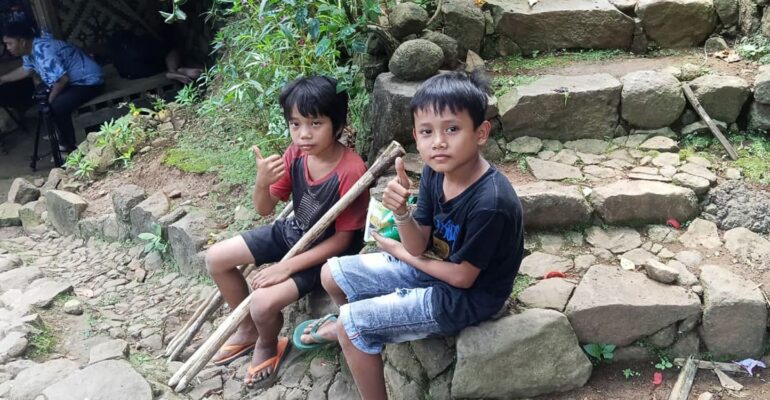
Other children were also seen enjoying playing with toy cars, manual toys made of wood, without being distracted by gadget screens. The open field in front of the house was still used as a soccer field.
This picture, said Fikri, conveys a strong message. “Childhood in Baduy Luar is still filled with real activities, not just focused on gadgets,” he said.
Meanwhile, Fikri found a different pattern among the younger generation of Baduy Luar. When they reach their teens, they begin to become engrossed and interested in gadgets. It is not uncommon for Baduy Luar teenagers to use gadgets to play games together (mabar) or watch comedy videos.
In contrast, parents use gadgets functionally, for example, for trading and communication. It is rare for them to become overly immersed in the virtual world.
Fikri said that this difference confirms the existence of boundaries maintained by the family, namely that children are directed to enjoy the real world while parents begin to use gadgets as needed, even though teenagers have begun to become addicted.
“This is where the importance of family-based traditional education lies. Baduy Luar parents not only give advice but also set an example,” he said.
Children, he continued, learn through real examples: seeing their parents go to the fields, weave, carry out family functions, and interact with relatives and travelers from all over the country. The values of mutual cooperation, simplicity, and respect for customs are naturally passed down through daily examples.
“Through this method, the internalization of values is not only cognitive but also affective and spiritual,” concluded Fikri.
According to him, this family-based traditional education has become a silent fortress for the Baduy tribe in the face of the onslaught of gadgets. They do not make a fuss with strict prohibitions but rather set an example through their daily lives.
“Parents organize their children’s growing space so that they remain in touch with customs, fields, simple games, and close social relationships. Even though teenagers are beginning to be lulled by gadgets and the virtual world, the basic values that have been instilled from an early age are expected to act as a filter in the use of technology,” he explained.
However, challenges remain. There is no guarantee that the younger generation of Baduy Luar will always be able to withstand the onslaught of gadgets and digital technology. The development of the times has made traditional boundaries increasingly flexible and the appeal of gadgets increasingly strong.
Nevertheless, Fikri believes that the family-based traditional education strategy provides wisdom that the family must be the main bastion in internalizing values so that children do not sink deeply into the vortex of gadgets and technology.
“Let’s learn from the Outer Baduy, education does not always have to be a formal curriculum, but also about role models, simplicity, and emotional attachment within the family,” he said.
In the midst of an increasingly “virtual” world, Prof Euis Sunarti, who is also a Professor at the Faculty of Human Ecology (Fema) at IPB University, also emphasized the vital role of the family in shaping the character of the younger generation.
“The family must continue to play a central role as the primary and first space in shaping the character of the younger generation. For the Baduy indigenous community, the family is a quiet fortress that safeguards the sacredness of traditions from the onslaught of gadgets and technology,” she stated. (*/Rz) (IAAS/ASY)

