
IPB University PKM Team Helps Women with Mental Disorders through Mindfulness-Based Art Therapy
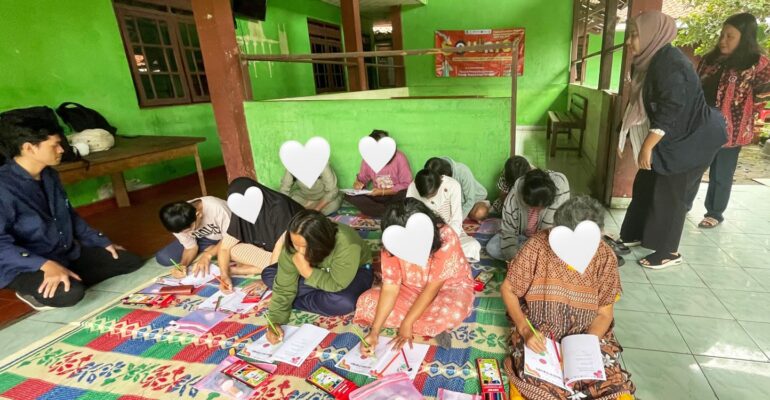
The IPB University Student Creativity Program in the field of Community Service (PKM-PM) launched the Soulrise program. This program aims to strengthen the self-resilience and emotional stability of women with mental disorders.
Team leader Rut Kristin Situmorang revealed that the idea was born out of her concern over the increasing number of mental disorder cases in Indonesia, especially among women.
“When the team visited YPKKSB (Yayasan Pembina Kesejahteraan Keluarga Semplak Bogor), we found 23 women with mental disorders, most of which were triggered by domestic problems and emotional trauma,” she explained.
From this concern, she and her team designed Soulrise to strengthen self-resilience through a humanistic and practical approach. This program is carried out using a Mindfulness-Based Art Therapy (MBAT) approach.
Rut explained, “This method combines mindfulness, which helps participants become more aware of the present moment, and art therapy, which provides a space for expressing emotions that are difficult to put into words.”
“Research shows that MBAT is effective in reducing symptoms of depression, making it relevant for implementation at YPKKSB,” she continued.
Furthermore, this program consists of three stages, namely Soul 1: Awakening the Self, Soul 2: Transforming Emotions, and Soul 3: Empowering the Soul, with eight core sessions. Activities include meditation, drawing, coloring mandalas, handicrafts, and planting plants. The program closes with SoulShowcase, an exhibition of participants artwork.
According to Rut, the biggest challenge is building trust with the beneficiaries. Some participants still harbor deep trauma, making it difficult for them to open up. In addition, fluctuating mental conditions make participation different in each session.
“With patience, consistency, and the support of YPKKSB administrators, these challenges can be overcome,” she explained.
Although it is still ongoing, positive impacts are beginning to be seen. Participants have become calmer, able to express themselves through art, and more socially involved. “Some are even more confident in presenting their work. We also see a sense of mutual support and togetherness forming,” added Rut.
In addition to Rut, the Soulrise team consists of Cahya Ardi Saputra and Nadira Alifia Rahmayani (Agricultural Engineering), Fahri Akbar Kuswanto (Communication and Community Development), and Karina Mulyaningsih (Aquatic Product Technology). This program is guided by Dr Defina, a lecturer at the Department of Family and Consumer Sciences, Faculty of Human Ecology (Fema), IPB University.
The team hopes that Soulrise can continue beyond the PKM program. “We have prepared a handbook, modules, and a pocket book so that the activities can be continued. The hope is that this model can be replicated in other institutions and receive government support, thereby becoming a tangible contribution from students in strengthening the mental health of Indonesian women,” he emphasized. (Fj) (IAAS/FMT)

