
IPB University PKM Team Extends the Shelf Life of Mas Bananas with Orange Peels and Cocoon Waste
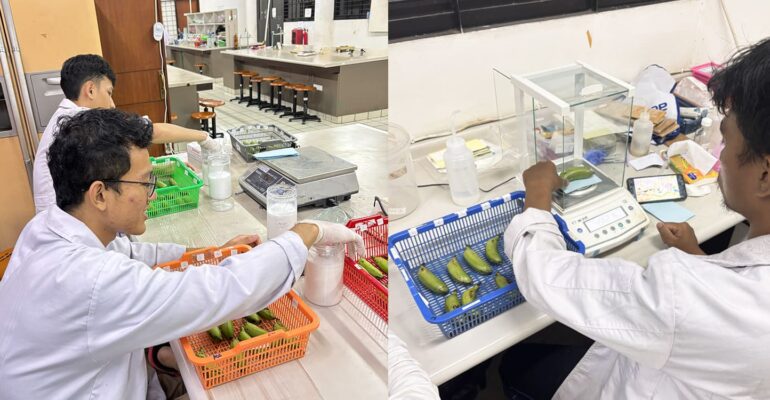
Who would have thought that orange peel and silkworm cocoon waste could save bananas from spoiling quickly? A group of IPB University students successfully transformed these two natural materials into a protective coating (nanocoating) that can extend the shelf life of mas bananas without additional chemicals.
This innovation was carried out by IPB University students through the Student Creativity Program (PKM). The team consisted of Samuel Pataniari Siahaan (team leader) and Ezekiel Royce Hamonangan, Ignatius Hadianto Pauta, Rivaldo Hutahaean, and Sarah Putri Ayunissa.
Their research is titled Multilayer Nanocoating Based on Sericin from Cocoon Waste and Pectin from Orange Peel to Increase the Shelf Life and Freshness of Mas Bananas (RE). This technology combines two separate layers of sericin (a protein from cocoon waste) and pectin (a compound from orange peel), which can slow down the ripening process of the fruit.
“After further study, it turns out that the shelf life of mas bananas can be extended with coating technology. There are many potential materials that have not yet been utilized,” said Samuel, the team leader.
In the trials conducted, untreated bananas showed full ripening and a decline in quality on the 6th day. Meanwhile, bananas that were given a nanocoating still retained their green color and stable physical condition.
Mas bananas are known as a fruit that ripens quickly because they have thinner skin compared to other types of bananas. This condition shortens their shelf life and increases the risk of post-harvest damage. This innovation is expected to help address these issues, while also reducing food waste and increasing the income of farmers and traders.
The main ingredients of nanocoating, namely silkworm cocoon waste and orange peel, are considered easy to find in various regions such as Temanggung, Yogyakarta, South Sulawesi, Gorontalo, as well as East Java and North Sumatra, which are the largest producers of oranges in Indonesia.
“Hopefully, the results of this research can be applied in the banana distribution chain, from harvest to consumer. Additionally, we want to expand the application of this innovation to other climacteric fruits,” added Samuel.
The team hopes that this innovation can continue to be developed and refined in further research until it becomes a marketable product and has a real impact on society and the agricultural sector in Indonesia. (dh) (IAAS/AVM)

