
IPB University-Astra Mentored Village Exports 15 Tons of Bajawa Arabica Coffee to Thailand
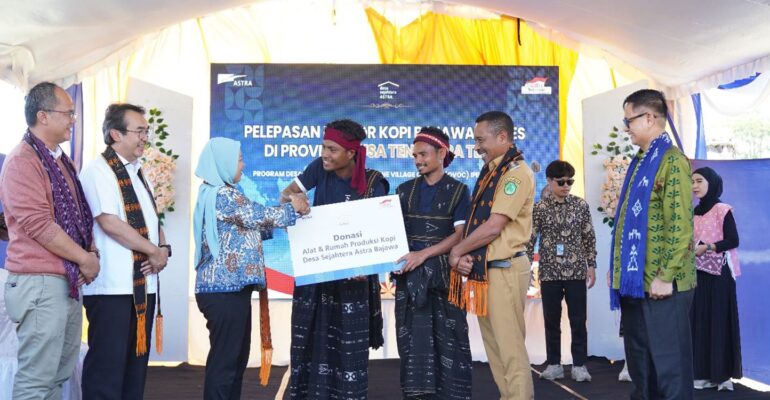
The synergy between the Directorate of Agromaritime Community Development (DPMA) of IPB University and PT Astra International Tbk has successfully delivered Bajawa arabica coffee to foreign countries independently for the first time.
The success of community development assistance through the implementation of the Astra Prosperous Village (DSA) and One Village One CEO (OVOC) programs by IPB University was marked by the release of 15 tons of Bajawa Arabica coffee worth Rp1,56 billion for export to Bangkok, Thailand.
“This is a historic moment for the people of Bajawa and East Nusa Tenggara Province (NTT) as today we have successfully shipped our first export of coffee (to foreign countries),” said Dr H Yusra, Director of Promotion and Marketing of Leading Products from Villages and Disadvantaged Regions, at the Ministry of Village, Development of Disadvantaged Regions, and Transmigration during the export launch at the Mukuvoka Village Hall, Bajawa District, Ngada Regency, NTT (10/13).
Bajawa coffee is known as one of Indonesia’s best coffees, having gained recognition in both domestic and international markets. Originating from the highlands of Flores Island, this coffee has a distinctive taste with main characteristics of pear, chocolate, fruity (orange and apple), and a strong spice aroma.
“This initiative is an important milestone in efforts to strengthen the competitiveness of Indonesian coffee commodities in the global market,” said Dr Handian Purwawangsa, Director of PMA IPB University, who was also present.
Dr Handian explained that the export of Bajawa Arabica coffee to Thailand was carried out through two business units of Desa Sejahtera Astra Bajawa, namely PT Rumah Kopi Bajawa and Koperasi Produsen Kopi Ekoheto Sejahtera. The involvement of these two business units is a form of strengthening community institutions and the business ecosystem in order to be competitive and sustainable.
“The character of the community empowerment program carried out by IPB is not only focused on improving productivity and post-harvest handling, but also on building a business ecosystem so that the added value of products can be higher and more competitive in the global market. The goal is for the assisted villages to be independent and improve their welfare,” said Dr Handian.
A similar sentiment was expressed by Prof Ernan Rustiadi, Vice Rector of IPB University for Research, Innovation, and Agromaritime Development. The IPB University DPMA is tasked with bringing IPB innovations to the community. This is none other than to provide the greatest possible benefits to the community.
“IPB University is not only a university that has received the best awards in the field of agriculture, but for us, the most important thing is that the community can feel the benefits of IPB’s presence,” said Ernan.
Previously, the great potential of Bajawa coffee faced various challenges. Many farmers faced various limiting factors, such as low cultivation competence, suboptimal post-harvest quality, traditional storage methods, and limited access to capital and markets. These conditions risked reducing the quality and taste of the coffee, which in turn could affect the selling price and community income.
Through intensive assistance from IPB University, the Arabica coffee commodity in Bajawa in 6 assisted villages, namely Naru Village, Wawowae Village, Mukuvoka Village, Ngoranale Village, Bolonga Village, and Bowali Village, has succeeded in improving the quality and productivity of coffee harvests to meet international export standards.
In addition to IPB University, support from PT Astra International Tbk in the form of production equipment and agricultural infrastructure as a catalyst in the Bajawa Arabica coffee business chain also contributed to the success of this first coffee export. Strong economic and social institutions are the pillars for business sustainability.
“With institutions in the form of cooperatives, limited liability companies (PT), or limited partnerships (CV), it is easier for the community to access capital from banking institutions,” said Diah Suran Febrianti, Head of the Environment and Social Responsibility Division at PT Astra International Tbk.
Meanwhile, Vice Regent of Ngada, Bernadinus Dhey Ngebu, SP, expressed his appreciation for the support from IPB University and PT Astra International Tbk, which has enabled the development of Ngada Regency to progress through the export of this coffee commodity.
“Building Ngada cannot be done alone; we must collaborate, and we would like to thank the Ministry of Villages, Development of Disadvantaged Regions, and Transmigration, IPB University, and PT Astra International Tbk for making Bajawa Arabica coffee known to the world market,” said Bernadinus. (*/Rz) (IAAS/FMT)

