
IPB University and BKSAP DPR RI Discuss Indonesia’s Strategy Amid New Globalization Dynamics
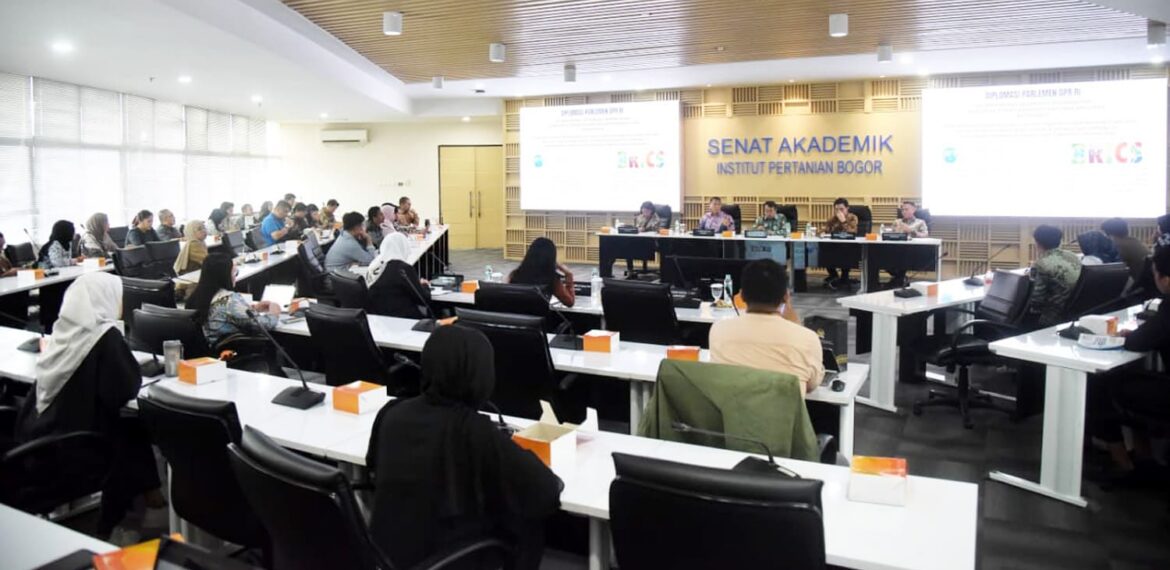
IPB University welcomed a visit from the Inter-Parliamentary Cooperation Agency (BKSAP) of the Indonesian House of Representatives (DPR) at the Dramaga Campus, Bogor, on Friday (10/17). This event was held as part of a strategic dialogue to discuss Indonesia’s position and role amid increasingly complex global changes.
Prof Ernan Rustiadi, Vice Rector of IPB University for Research, Innovation, and Agromaritime Development, expressed his appreciation for the visit by BKSAP, which he considered to have an important role in strengthening Indonesia’s parliamentary diplomacy in the international arena.
“BKSAP is an important bridge for inter-parliamentary diplomacy. Indonesia’s voice needs to continue to be echoed in various international forums, especially regarding humanitarian values and global solidarity,” he said.
He emphasized that Indonesia is now increasingly recognized as an influential middle power in the world, not only because of its population or geographical position, but also because of the nation’s ability to maintain unity in diversity and share its development experiences with the world.
“Since its inception, IPB has upheld Bung Karno’s message that the life and death of a nation is determined by its ability to provide food. Therefore, IPB is committed to becoming a Global South Leader, bringing Indonesia’s agromaritime excellence to the world level in the next five years,” he said.
Meanwhile, Dr Alfian Helmi, Director of Cooperation, Communication, and Marketing (DKKP) at IPB University, explained that the world is now entering a phase of fragmented globalization, an era in which countries collaborate selectively and strengthen national resilience.
“Globalization is no longer completely open. Countries choose who they work with, and this requires stronger national preparedness,” he said.
According to him, Indonesia has a unique position because it is trying to be part of two major world blocs, namely the OECD (Organisation for Economic Co-operation and Development) and BRICS (Brazil, Russia, India, China, South Africa). The OECD represents developed countries with a focus on governance and regulatory reform, while BRICS emphasizes the sovereignty and solidarity of Southern countries.
“Indonesia can be a bridge builder between the North and South. However, a grand design is needed to remain aligned with national interests,” he added.
In his presentation, Dr Mardani Ali Sera, Chair of the Indonesian House of Representatives’ Special Committee on Foreign Affairs, assessed that Indonesia’s membership in the OECD and BRICS is an important momentum to strengthen Indonesia’s global position.
“The OECD demands major reforms, while BRICS opens access to more inclusive markets and financing. However, each membership has consequences. Like marriage, freedom is reduced, but responsibilities and opportunities increase,” he said.
He emphasized the importance of synergy between academics and parliament. “All of Indonesia’s involvement in international forums must lead to the welfare of the people. We hope that IPB can enrich the results of the BKSAP Working Committee with research and academic perspectives,” he concluded. (AS) (IAAS/LAN)

