
IPB University Academics: Blue Food Potential Must Be a National Development Priority
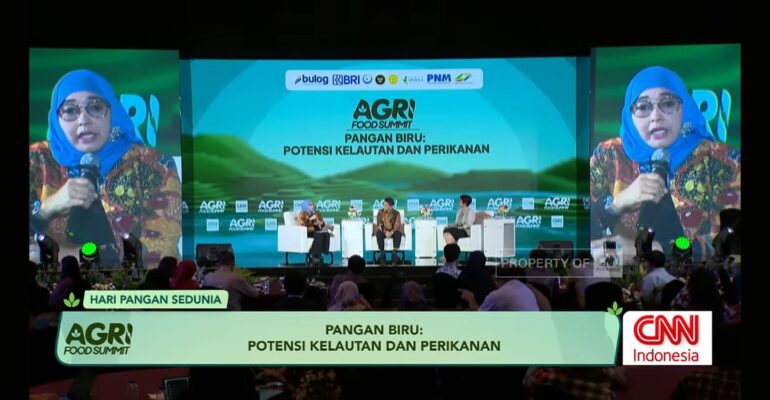
With 70 percent of its total area covered by sea, Indonesia must make blue food potential a national development priority. This was conveyed by Dr Nimmi Zulbainarni at the “Agrifood Summit: Paving the Way for Indonesia Towards World Food” organized by CNN Indonesia on Thursday (10/16) in Jakarta.
Dr Nimmi emphasized that the development of the marine and fisheries sector cannot only pursue production and profit, but must also pay attention to environmental sustainability and marine ecosystem sustainability.
“The development of capture fisheries and aquaculture potential should not be solely for profit. The environment, the sea, and public health must be preserved. We are talking about healthy oceans, healthy people, and a healthy planet,” she said.
According to this lecturer at the IPB University School of Business, the approach that must be used in blue food development is a systemic approach, not a sectoral one. To that end, he encourages the formulation of a comprehensive and integrated national blue food roadmap.
However, Dr Nimmi also revealed that Indonesia currently faces various challenges, particularly related to logistics and the cold chain, which are crucial in maintaining the quality of perishable fishery products.
She also highlighted the importance of modernizing fishing vessels and managing fishing zones. According to him, fisheries policy must be based on a balanced biological and economic approach in order to compete with countries such as China and Japan, which are more advanced in blue food systems.
Furthermore, Dr Nimmi explained that to strengthen Indonesia’s position as a global seafood producer, sustainable aquaculture needs to be developed for leading commodities such as tuna, shrimp, lobster, crab, and crab.
However, she warned that environmental aspects should not be neglected. For example, some Indonesian aquaculture products have been rejected by export markets, especially the United States, due to heavy metal contamination around industrial areas.
“To penetrate export markets, fishery products must meet food safety and sustainability certifications. Otherwise, the destination country may reject them, as in the case of Banten,” she said.
On that occasion, the Director General of Marine and Fisheries Product Competitiveness Strengthening at the Ministry of Marine Affairs and Fisheries, Machmud, SP, MSc, emphasized that the government has taken a holistic approach as stipulated in the Fisheries Law. These measures include marine spatial planning, the development of conservation areas, and the provision of quality and food safety certification. (dh) (IAAS/NRA)

