Green Campus, IPB University Strengthens Tree Fall Risk Management on Campus
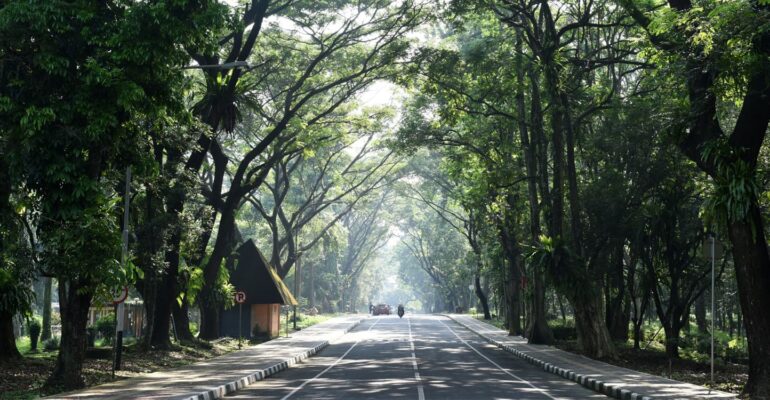
Shady trees are a hallmark and pride of IPB University. However, the presence of thousands of trees across the vast campus area also poses potential risks, especially during the rainy season and strong winds.
To address this, IPB University, through the Office of Risk Management (KMR), in collaboration with the Directorate of General Affairs and Infrastructure (DUI) and tree experts from the Faculty of Forestry and Environment (Fahutan), continues to strengthen the prevention and mitigation system for tree-fall risks.
The Chairman of the Office of Risk Management at IPB University, Dr Budi Purwanto, explained that the management of tree-fall risks at IPB University follows the Three Lines Model framework with KMR acting as the risk management facilitator, DUI as the technical operator, and Fahutan as the provider of professional expertise. The involvement of faculty deans is also emphasized to ensure faster, more contextual, and more effective area management.
“The steps include routine pruning, monitoring tree health, and taking emergency action when hazardous conditions are detected. Each tree fall incident is also evaluated to improve the existing system,” he stated.
As a foundation for implementation, IPB University has established specific guidelines through a Rector’s Decree on the Commitment to Implement the Occupational Safety and Health Management System (SMK3) and has also issued the Occupational Safety, Health, and Environment Management Guidelines (SMK3L) in 2020.
“These guidelines serve as a reference for regular inspections, hazard reporting, and standard operating procedures (SOPs) for emergency response,” Budi explained.
The process of identifying trees at risk of falling is carried out through visual inspections. The team checks the condition of roots, trunks, branches, and tree inclination, as well as signs of pest or disease damage.
However, Budi acknowledged that managing risks across a campus spanning hundreds of hectares with thousands of trees is not an easy task. “It’s impossible to completely eliminate the risk because trees are living organisms that continuously grow and change. The challenge is to maintain a balance between environmental sustainability and the safety of the academic community,” he said.
The role of the academic community is also considered vital. Students, lecturers, and staff can report findings of potentially hazardous trees through the official IPB Help Center channel. “This participation is part of the risk-aware culture we are continuously developing on campus,” Budi added.
Budi also shared experiences from a rapid response case involving a fallen tree on the main campus road. “Once a report comes in, the DUI team immediately moves to evacuate and normalize access without waiting for external assistance. Fahutan provides technical advice on tree health, pruning, or long-term mitigation, while KMR ensures the risk management aspects remain under control,” he explained.
Through cross-unit collaboration, clear regulations, and active participation from the academic community, IPB University is committed to building a risk-aware culture while ensuring that the green and lush campus environment remains safe and sustainable. (Fj) (IAAS/AVM)