
Exploring Wild Mushrooms on the IPB University Campus, Lecturer: Potential as Bioremediation Agents and Functional Foods
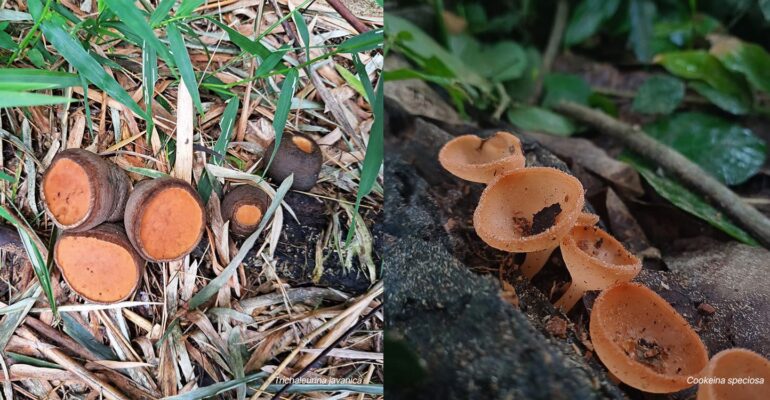
Behind the lush forests and green areas of IPB University lies a wealth of biodiversity that is more than just a beautiful sight. There are many things to explore to prove that Indonesia is a megabiodiversity country, one of which is wild mushrooms.
These organisms are often overlooked, but are now the focus of crucial research, especially by experts at IPB University. Dr Ivan Permana Putra, a lecturer and researcher in the field of mycology (the study of fungi), has led the exploration of wild mushrooms on campus since 2015.
Dr Ivan explained that although Indonesia is widely recognized for its biodiversity, specific data proving the existence of mushroom species is still very minimal compared to global estimates.
IPB University’s commitment to this research has grown stronger with the establishment of the Mycology Division. This has positioned IPB University as a trendsetter in the field of mycology in Indonesia.
The exploration conducted by Dr Ivan and his team has discovered the great potential of wild mushrooms from the campus environment. One of the most interesting findings is their role as agents of bioremediation or natural environmental cleaners.
“In one study, a type of fungus, Favolus, was identified that showed an extraordinary ability to absorb harmful heavy metals such as lead (Pb). This discovery opens up new avenues for utilizing campus biodiversity in the treatment of contaminated land, such as former mining sites,” said Dr Ivan.
In addition to its role as an environmental savior, wild fungi at IPB University also promise solutions to global food challenges. Many of the fungi explored have the potential to become a source of functional food because they are known to be high in fiber and low in cholesterol, supporting efforts to achieve food security and zero hunger targets.
More than just laboratory results, fungal diversity also reflects the overall health of the IPB University ecosystem. The presence of lichen (crustose lichens) that thrive and abound on campus is a strong indicator that the IPB University environment has minimal air pollution.
“The key to a Biodiversity Campus is diversity. If it is diverse, the place is healthy and balanced,” concluded Dr Ivan.
Through systematic and collaborative exploration, IPB University not only maintains its status as a Biodiversity Campus but also reinforces its role as a natural laboratory consistently producing scientific innovations.
This fungal research demonstrates that solutions to modern environmental and food challenges are often right before our eyes, amidst the campus’s own biological richness. (Ez) (IAAS/Ard)

