
Dairy Boost: Innovation from IPB University’s PKM Team, Effectively Increases Milk Production by Up to 30 Percent
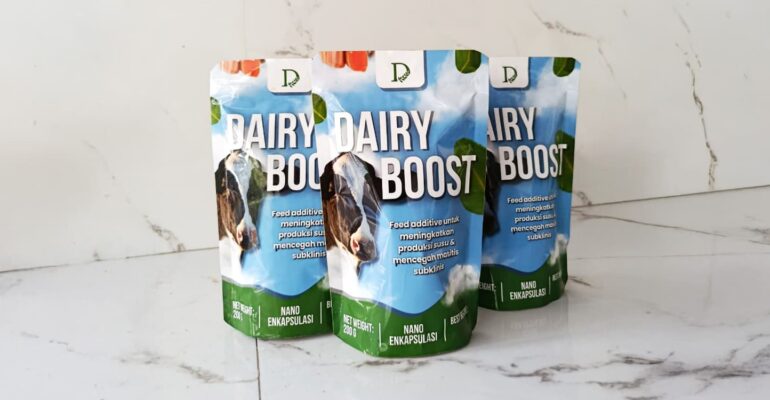
The Student Creativity Program (PKM) team from IPB University presents Dairy Boost, a feed additive product made from katuk leaf extract, turmeric, and proteinate minerals developed using nanoencapsulation technology.
This product is designed to increase the quantity and quality of dairy cow milk production, while maintaining udder (milk gland) health and helping to reduce dependence on imported dairy products.
Saffanah Noor Faradisa, a representative of the team, revealed the reason behind the creation of Dairy Boost. This product, she said, was inspired by the problem of low dairy cow milk productivity in Indonesia.
“Currently, around 78 percent of domestic milk demand still has to be met through imports. Not only that, subclinical mastitis and limited feed quality are also factors hindering milk production,” she said.
Saffanah said that laboratory test results showed promising results. The use of Dairy Boost can increase milk production by up to 30 percent and show antibacterial activity against bacteria that cause subclinical mastitis through inhibition zone tests.
The choice of katuk leaves and turmeric as base ingredients was not without reason. Katuk leaves contain active compounds such as terpenoids that stimulate the mammary glands. Turmeric is known to have galactogogue properties and contains curcumin, which has antibacterial properties against the causes of mastitis. Meanwhile, Zn and Se proteinate minerals play a role in maintaining the immune system and strengthening the stability of the udder membrane.
Interestingly, the team chose mature katuk and turmeric leaves, which are generally not consumed by humans, thus avoiding conflicts with food availability. This makes Dairy Boost an environmentally friendly and sustainable product.
Saffanah admitted that one of the main challenges in animal feed is the degradation of active compounds in the cow’s stomach, particularly in the rumen, which is the first digestive compartment. “This is where nanoencapsulation technology plays an important role,” said Saffanah.
“This technology allows the active compounds from katuk leaves and turmeric to be protected from rumen microbial degradation. The nano particles will protect the compounds until they reach the small intestine, where optimal nutrient absorption occurs,” she explained.
Additionally, by utilizing the interaction between positively charged chitosan and negatively charged sodium tripolyphosphate, the resulting nano-layer not only protects the compounds from pH and enzymes but also enhances the bioavailability of bioactive compounds. As a result, the effectiveness of the compounds increases, and the health benefits for cattle are more pronounced.
Together with her teammates, Saffanah believes this product has great potential for commercialization. With a selling price of IDR 35.000 per 200 grams and a daily dose of only 20 grams per cow, the increase in milk production provides an additional income of around IDR 17.500 per cow per day for farmers.
“Dairy Boost is not only economically efficient but also empowers local farmers,” she added.
Moving forward, Dairy Boost will focus on downstream processing and industrial-scale production. The team plans to collaborate with industries and work alongside local farmers. Additionally, scientific publications will be conducted to strengthen the product’s credibility and public trust.
“We aim to support local farmers in adopting environmentally friendly and efficient feed technology. Through Dairy Boost, we hope to make a tangible contribution through sustainable milk production,” she concluded. (AS) (IAAS/FMT)

