Coconut Squirrels, an Important Indicator of the Health of the IPB University Campus Ecosystem
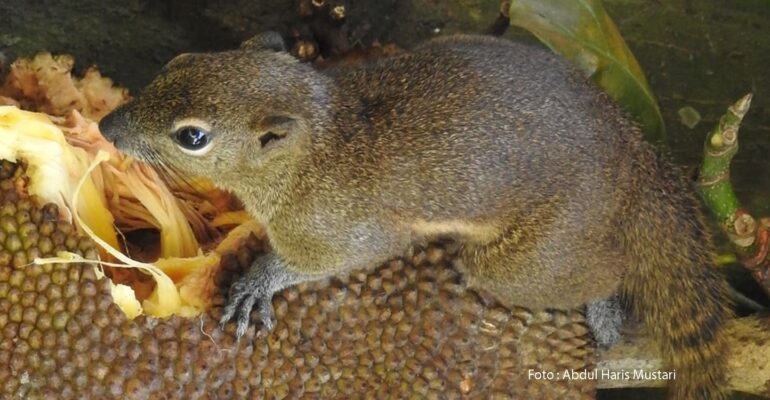
Behind the lush trees of the IPB Dramaga Campus lives a small mammal that plays a major role in maintaining the balance of nature: the coconut squirrel (Callosciurus notatus). Its agile movements are often seen among the tree branches, as if it were an integral part of the green life of the campus.
“Coconut squirrels are not only inhabitants of the trees, but also an important indicator that the IPB Campus ecosystem is still healthy,” said Dr Abdul Haris Mustari, Wildlife Ecology Expert at IPB University.
This wild animal, classified under the order Rodentia, is known for its high adaptability to various types of habitats, ranging from primary forests, secondary forests, plantation areas, to environments influenced by human activities.
Despite being known as “coconut rats,” these animals actually have a much more diverse diet. “In addition to coconuts, they also enjoy eating papaya, bananas, jackfruit, cempedak, and matoa,” explained Dr Haris.
Not only that, coconut squirrels also eat various types of figs (Ficus hispida, F. racemosa, F. benjamina), kibolong fruit (Cecropia peltata), pine fruit (Pinus merkusii), and African wood (Maesopsis eminii) that grow around the campus forest.
This diversity of food sources enables coconut squirrels to survive in various environmental conditions, both natural and artificial.
However, their main role does not stop there. Through their feeding activities, coconut squirrels also help with seed dispersal and natural tree regeneration. “These small mammals act as seed dispersal agents. Therefore, their presence is very important for maintaining the regeneration of the campus forest,” he added.
Interestingly, coconut squirrel populations are also found in areas with dense human activity, such as the Lecturer Housing Complex at the IPB Dramaga Campus. This proves their extraordinary ability to adapt to urban environments.
“They were already here before the campus was built. Coconut squirrels are actually able to adapt to environmental changes,” said Dr Haris.
Despite their relatively high population, coconut squirrels do not pose a risk of population explosion as they are still controlled by natural predators such as civets, jungle cats, snakes, eagles, and owls. Their presence, alongside other wildlife on campus, signifies that nature and humans can coexist harmoniously.
“Taking a morning walk on campus, seeing the lush trees and squirrels running along the branches, that’s a special sight,” concluded Dr Haris. (*/Rz) (IAAS/Ard)