Circular Economy Becomes Mainstream in Development, IPB University Hosts PA3KN Goes to Campus
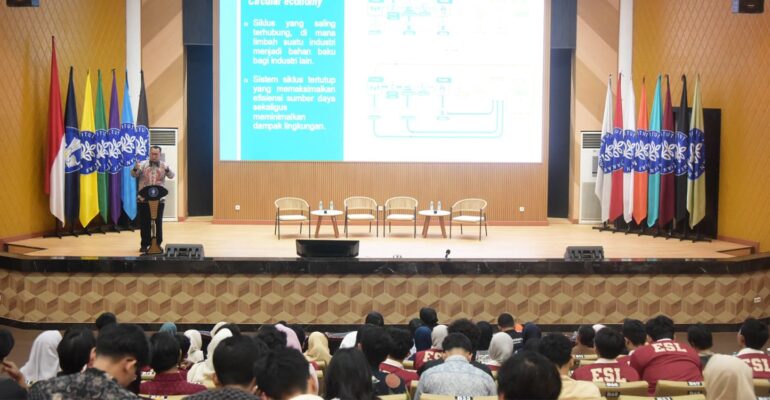
IPB University became the host of the National Seminar entitled “Opportunities, Challenges, and Solutions for Optimizing the Implementation of the Circular Economy.” The event took place in the Andi Hakim Nasution Auditorium, IPB Dramaga Campus (10/2).
The event was organized by the Center for Analysis of State Budget and Financial Accountability (PA3KN) of the House of Representatives (DPR) of the Republic of Indonesia together with the Resources and Environmental Economics Student Association (REESA) of the Faculty of Economics and Management (FEM) IPB University.
This activity, which is part of the PA3KN Goes to Campus series, featured various speakers, ranging from the Head of PA3KN Setjen DPR RI, Dr Furcony Putri Syukriani, to IPB University academics such as Rector Prof Arif Satria, Prof Eka Intan Kumala Putri, and Dr Siti Nikmatin. Also present was environmental practitioner Ir Mukhlis, founder of Rumah Anorganik.
In his keynote speech, Prof Arif Satria emphasized that the success of circular economy implementation does not only depend on regulations or technology, but also on mindset. “The most important thing is mindset. This mindset determines how we can encourage a sustainable productive process,” he said.
Prof Arif exemplified the use of simple technology that can drive the transformation of the circular economy, such as the utilization of palm oil waste for green composite raw materials or the processing of agricultural residues into animal feed.
He also emphasized the importance of the role of higher education institutions in preparing human resources. “Circular economy is an approach that must become mainstream in development. IPB is ready to collaborate with the DPR RI through PA3KN to strengthen policy analysis, so that its implementation can answer challenges and also create new opportunities for society,” he explained.
The Rector also asserted that the benefits of the circular economy must be widely felt, not just by certain groups. “Products must be continuously used to provide added value, reduce social costs, and deliver broader economic benefits. That way, we not only protect the environment, but also create prosperity for society,” Prof Arif stressed.
Meanwhile, Chairman of PA3KN Dr Furcony emphasized the importance of collaboration between PA3KN, higher education institutions, and society. “The PA3KN Goes to Campus program is not just a discussion forum, but also a means to build a knowledge network. We want to provide students with direct understanding of the state budget cycle and how the circular economy can be part of the solution for national development,” she explained.
The discussion at this event highlighted the urgency of the circular economy as a solution to face the Triple Planetary Crisis—climate change, pollution, and biodiversity loss.
Through this seminar, PA3KN hopes to gather input from IPB University academics to strengthen the substance of the analysis that will be submitted to the DPR RI. The results are expected not only to enrich regulations, but also to build synergy between legislative institutions, universities, and society in realizing sustainable development. (Fj) (IAAS/KMR)