
Addressing Elephant-Human Conflict, Academics Collaborate to Do This
Conflicts between humans and elephants often occur due to competition for living space and resources. Conflicts can take the form of: destruction of agricultural land, settlements, and infrastructure by elephants; humans being injured/killed while trying to chase away elephants; conversely, elephants being killed, trapped, poisoned, or shot in retaliation; destruction of elephant habitats (clearing forests for agriculture, settlements, and industry causes elephant habitats to become fragmented), elephants losing their natural migration routes and being forced to approach human areas.
Another form of conflict is the use of dangerous methods to repel elephants, such as firecrackers, electricity, trenches, fire fences, or poison. These methods can endanger the safety of both elephants and humans.
The Center for Environmental Research – International Research Institute for Environment and Climate Change (PPLH LRI) at IPB University, in collaboration with Aceh Green Conservation (AGC), is paying close attention to this conflict. Joint research is being conducted with the aim of strengthening the capacity of the Aceh customary government apparatus, particularly the Mukim institution, in the sustainable management of land in zones of conflict between elephants and humans.
The Ulu Masen Forest, an area covering 738 hectares spread across seven districts in Aceh, has been designated as an action research area. This research involves academics/researchers from IPB University, the National Research and Innovation Agency (BRIN), Syiah Kuala University, Jember University, Teuku Umar University, Ibnu Khaldun University, and local partners from AGC.
This research is funded by a global competitive grant from Explore RECOFTC – The Center for People and Forest (supported by the Swedish government), an international organization focused on community forestry and community-based natural resource management. The grant support from RECOFTC demonstrates recognition of the importance of collaborative research for better forest landscape management.
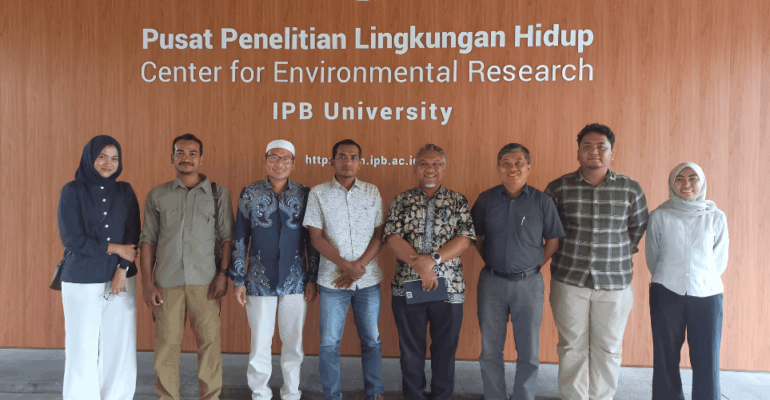
To finalize the Research Planning and Design, researchers and conservation practitioners involved in the management of the Ulu Masen forest area met for in-depth discussions held in Bogor on October 23-25, 2025.
A comprehensive research framework was developed to support sustainable and evidence-based forest landscape management, including strategies to mitigate human-elephant conflict, which is a serious threat in the area.
Dr Yudi Setiawan, Chairman of PPLH IPB University, said that the Ulu Masen forest landscape in Aceh plays a strategic role in biodiversity conservation, carbon storage, and the provision of ecosystem services for local communities. “This area is an important habitat for the endangered Sumatran elephant population, as well as other critically endangered species such as the Sumatran tiger. However, the increasing human-elephant conflict due to agricultural land expansion into elephant habitats poses a major challenge to conservation efforts,” he said.
He further said that this is not just conservation action research. “This is a direct investment in the long-term sustainability and justice of the Ulu Masen landscape. It is hoped that the initiation of this model will be sustainable, impactful, and provide input for decision-making in Aceh and learning at the global level,” he said.
He also emphasized, “By placing the Mukim community and their deep historical knowledge at the center of governance, we will create a model that can be replicated and adapted locally, which not only ensures the future of Sumatran elephants but also builds climate and economic resilience for local families.”
From this in-depth discussion, he hopes that a research design will be developed that is capable of addressing the challenges of sustainable forest management by involving various parties.
“This meeting in Bogor is expected to produce a clear and measurable research roadmap, as well as strengthen the collaborative network between academic institutions, civil society organizations, and local communities in preserving the Ulu Masen forest. Special focus will be given to developing evidence-based strategies to address human-elephant conflicts, improving forest governance, and enhancing the welfare of communities around the area,” he said.
Dr Tjahjo Tri Hartono, Principal Investigator in this research, said, “This collaboration is very important to build a strong foundation for action research. Support from RECOFTC allows us to design an integrative and applicable research approach for the management of the Ulu Masen forest landscape, including efforts to overcome human-elephant conflicts that have caused economic losses to the community and threats to the elephant population.”
Meanwhile, Ilhami, Chair of Aceh Green Conservation, said, “This research collaboration is an important moment to synergize academic knowledge with field practice. We are committed to continuing to support research efforts that contribute to the preservation of the Ulu Masen forest and the welfare of the surrounding community. The collaboration with PPLH IPB University will strengthen the scientific basis for conservation decision-making and the implementation of conservation programs in the field.” (IAAS/LAN)

