
Shrimp Eating Campaign Amidst Cesium-137 Radioactive Exposure Issues Held During FPIK IPB University Talkshow and Business Meeting
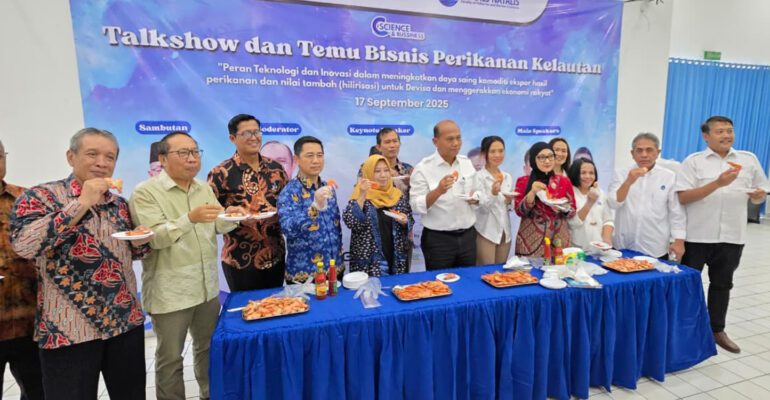
The Faculty of Fisheries and Marine Sciences (FPIK) at IPB University, in collaboration with the Indonesian Crustacean Society (MKI), held a Shrimp Eating Campaign during a Fisheries and Marine Sciences Talk Show and Business Meeting. This campaign was an effort to increase public confidence that consuming shrimp is still safe and healthy amid concerns about exposure to radioactive cesium-137.
The Talkshow and Business Meeting discussed the phenomenon of Indonesia as a maritime country with abundant marine resources but still facing a number of problems. One of the major challenges is how to transform the potential of fisheries into a driver of national economic growth.
The event invited speakers from the Ministry of Maritime Affairs and Fisheries (KKP), namely Dr Tb Haeru Rahayu (Director General of Aquaculture) and Machmud, SP, MSc (Secretary of the Directorate General for Strengthening the Competitiveness of Marine and Fishery Products). Also present were Ir Hardi Pitoyo (Banyuwangi Shrimp Farmer) and Mr Pham The Cuong (Commercial Counselor of the Embassy of the Socialist Republic of Vietnam in Indonesia).
The speakers conveyed the importance of technology, innovation, and downstreaming of fishery products. Post-harvest technology, cold chain systems, and modern processing methods can make a significant difference in improving the quality and competitiveness of exports.
Downstreaming means shifting the orientation from simply exporting raw fish to high value-added processed products, such as fillets, ready-to-eat frozen products, canned foods, and fish oil-based supplements. This step not only increases foreign exchange earnings but also opens up new job opportunities in the processing industry.
In addition, technology and innovation must also be directed towards driving the people’s economy. Small fishermen and micro, small, and medium enterprises (MSMEs) can be involved in the fish processing industry ecosystem. Support in the form of simple technology such as portable refrigerators, access to financing, and fish processing training can increase income.
The transformation of the fisheries sector through technology, innovation, and downstreaming is not just an option, but an urgent need to strengthen economic sovereignty. This requires formulating strategies that not only increase export competitiveness and foreign exchange earnings, but also ensure the welfare of the people through a more equitable distribution of benefits.
Only with an approach that combines global competitiveness and people’s empowerment can Indonesia’s fisheries become the driving force for sustainable national development.
The event concluded with a business meeting with business actors and the signing of a cooperation agreement between FPIK IPB University and a number of partners. These include MKI, Agrinas Jaladri, Nurul Taqwa Waqf Foundation-PT Indosat, PT Geltech Prima Indonesia, Cleenshet, Lebak District Bapelitbangda, Nusantara Palabuhanratu Fisheries Port, and Auto2000 (PT Astra). (*/Rz) (IAAS/RMH)

