IPB University’s Contribution to the SustainPalm Project, Promoting Innovative Solutions for Sustainable Palm Oil
IPB University is contributing to the SustainPalm project, a collaboration between Indonesia and the Netherlands that has been running for the past three years.
This project aims to create innovative solutions for sustainable palm oil practices. It involves IPB University, Lambung Mangkurat University (ULM), Wageningen University and Research (WUR), and Van Hall Larenstein University of Applied Sciences (VHL), with support from the Dutch Ministry of Foreign Affairs and the Coordinating Ministry for Economic Affairs of the Republic of Indonesia.
The Rector of IPB University, Prof Arif Satria, said that collaborative research in this project is important to ensure the sustainability of the national palm oil industry.
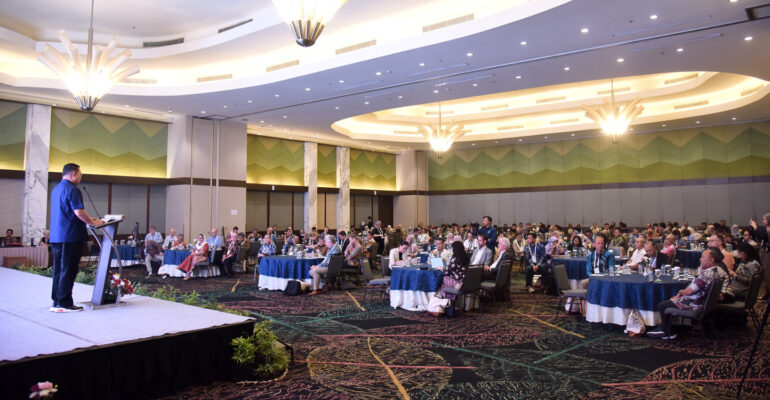
“One of our focuses is to utilize palm oil waste into useful products. From waste to wealth, as part of the circular economy approach,” he said at the SustainPalm Annual Meeting at the IPB International Convention Center, Bogor, Monday (9/2).
Furthermore, he emphasized that SustainPalm has proven that sustainable palm oil is not just a discourse, but a concrete action that can be realized when various parties work together.
“SustainPalm is a joint journey that proves that the palm oil sector can support livelihoods while protecting the earth for future generations. Even though the project has ended, the spirit of collaboration and sustainability values must continue to live on, becoming the foundation of policy, strengthening communities, and taking root in the DNA of Indonesia’s palm oil industry,” he said.
SustainPalm focuses its activities on improving palm oil practices that are efficient in land use, environmentally friendly, and inclusive of smallholders. The project promotes the Communities of Practice (CoPs) and LivingLabs (LLs) approaches to formulate joint solutions at the local level.
One of the innovations developed through this project is the Palm Oil-Cattle Integration System (SISKA), which is the result of research by IPB University. SISKA combines palm oil cultivation with cattle farming to increase added value for farmers. The project also develops an intercropping system, which is the planned cultivation of more than one type of crop on a single plot of land.
Intercropping has been proven to increase productivity, land use efficiency, and soil health, as well as help control pests naturally. Crops such as bananas, peanuts, and coffee are examples of crops that are grown alongside oil palm to create ecological and economic benefits.
Through SustainPalm, it is hoped that the research results will not only remain in the realm of academic study, but will also bridge the worlds of research, policy, and field practice to create a real impact on the sustainability of Indonesia’s palm oil industry.
The event was attended by several distinguished guests, including Dida Gardera from the Ministry of Economy, Prof Jan Verhagen, SustainPalm Program Manager, Joost van Uum from the Embassy of the Kingdom of the Netherlands, and representatives from several domestic university partners. (dh)(IAAS/FMT)