
IPB University Sociologist: Demonstrations are a Social Mirror, Government Response Will Determine Indonesia’s Future
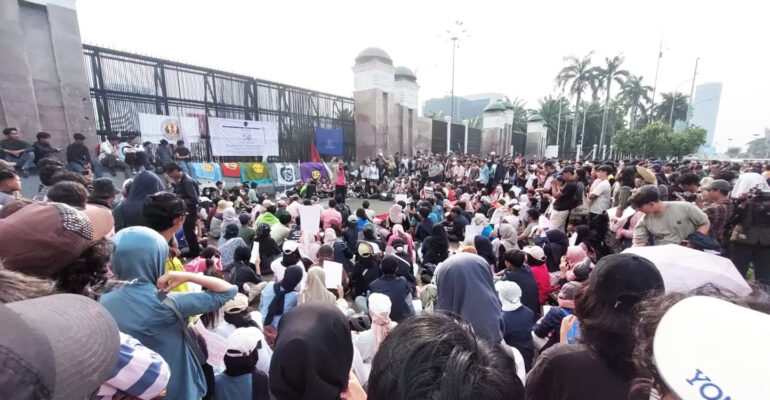
The wave of demonstrations that continued to emerge throughout August to September 2025 was seen as a strong signal of a widening socio economic gap in Indonesia. This was confirmed by Dr Ivanovich Agusta, a sociologist at IPB University, who referred to demonstrations as “social events” that serve as a test for the relationship between the people and the state.
“Demonstrations are a dissociative social process, born out of conflict between the government and the people. The government here is not only the executive, but also the legislature, and even tends to group together with the judiciary. This pattern has been identified by Levitsky and Ziblatt in their study of fragile democracies,” he said.
According to Dr Ivanovich, the dominant factor driving students and the public to take to the streets is the widening socio-economic gap. He highlighted the irony when the World Bank announced Indonesia’s poverty rate at 68 percent, while the gross national income (GNI) per capita had reached USD 16.010 in 2024.
“When the wealth of state officials is exposed to the public, while the people can only live subsistence lives, demonstrations become a rational choice. The risk of loss for the common people is almost non-existent, because they have already lost so much,” he explained.
He assessed that the main trigger for the recent wave of protests was actually the words and behavior of officials. “From the case of the Pati Regent’s remarks on August 13 to the dancing and arrogance of other officials, this pattern shows the habitus of the upper class who look down on the lower class,” he said.
Dr Ivanovich reminded that the recent demonstrations show a different pattern from 1998. If in the past the actions ended in looting of malls and ethnic tragedies, now the focus of the masses’ anger is directed at officials who are considered to be harming the people. In fact, Molotov cocktails have begun to appear in response to tear gas and water cannons fired by the authorities.
“This is clearly an escalation. The people are responding to the authorities’ violence. The first step that the executive and legislative branches must take is to sincerely apologize for miscommunicating with the people,” he said.
In addition, he urged the government to stop the violence against demonstrators, improve governance through meritocracy and transparency, and provide business and employment opportunities for marginalized groups.
“Data and science must be the basis for policy, not the opinions of elites who are far removed from the reality of the people,” he added.
Dr Ivanovich believes that Indonesia is now at a crossroads. If the aspirations of the people are answered with real reforms, the nation can move towards a transparent and meritocratic democracy.
However, he emphasized that if the government’s response remains repressive, the opposite direction will actually strengthen oligarchy, corruption, collusion, and nepotism, and a closed state controlled by a handful of elites.
“The response of the executive, legislative, and judicial branches will always be met with a response from the people. That is a social law. The choice is simple: does this nation want to improve itself in a more fair manner, or does it want to sink into a vortex of increasingly closed power?” he concluded. (AS) (IAAS/ASY)

