IPB University Restores Aquatic Ecosystems Through Four Conservation Actions in Sukabumi and Purwakarta
The Department of Aquatic Resource Management (MSP), Faculty of Fisheries and Marine Sciences (FPIK) at IPB University has made a concrete commitment to restoring aquatic ecosystems through four conservation actions in Sukabumi and Purwakarta.
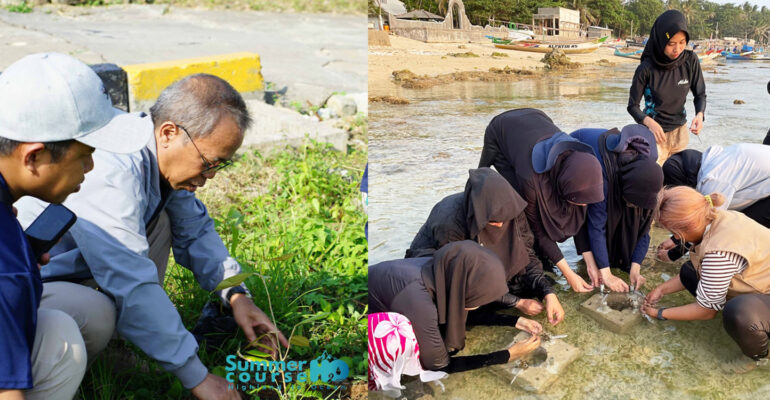
The four actions are planting riparian trees in Cirata Reservoir, transplanting coral in Ujung Genteng waters, releasing green turtle hatchlings on Pangumbahan Beach, and planting mangrove seedlings at the mouth of Cikadal, Ciletuh Geopark.
The Chairman of the MSP Department at IPB University, Prof Hefni Effendi, said that this activity serves as a crucial bridge for all stakeholders to jointly build awareness of the environment, especially the aquatic environment.
This activity is part of a series of events for the 2025 Highland to Ocean (H2O) Summer Course with the theme “A Tapestry of Aquatic Biodiversity Thriving for a Sustainable Future,” involving 18 international participants from 5 countries, academics, and strategic collaborations with PT PLN Nusantara Power, the Mandrajaya Community Monitoring Group (Pokmaswas), the Ujung Genteng Community Monitoring Group (Pokmaswas), and the Pangumbahan Turtle Conservation Center.
Lecturer at the MSP Department and Chief of the event, Muhammad Irfan Afif, M.Sc., said that this year’s event felt different from usual. “We are working with industry and community groups to build an ecological footprint that is beneficial to the environment and memorable for everyone involved,” he said.
The activity began with the planting of 50 riparian trees consisting of Durio sp., Artocarpus heterophyllus, and Persea americana on the north side of the Cirata Reservoir, carried out in collaboration with PT PLN Nusantara Power and PMSE.
“The seedlings planted on the reservoir banks are expected to strengthen the natural embankments around the reservoir and be able to withstand erosion around the reservoir. These trees were chosen so that the community can later harvest the fruits,” he said.
Furthermore, in the waters of Ujung Genteng, Sukabumi, 10 coral transplants were carried out using the square substrate method. Fragments of hard coral (Acropora spp.) were planted at a depth of 1,5 meters in an area of 100 m² using a cube substrate.
This transplantation method was chosen because it was considered the most effective among other methods, as the Ujung Genteng Community-Based Marine Conservation Group had conducted trials for years. The transplantation will be monitored three months later, and it is hoped that the survival rate will exceed 40 percent.
Next, Pangumbahan Beach became the location for the release of 50 green turtle hatchlings (Chelonia mydas) from a semi-natural hatching site. This action was technically assisted by the Pangumbahan Turtle Conservation Center. In addition to the release, participants were also invited to see various facilities at the conservation site.
At Ciletuh Geopark, Sukabumi, 100 Rhizophora mucronata mangrove seedlings were planted on 0,5 hectares of rehabilitated land around the Cikadal estuary. This action was guided by the Mandrajaya Community Group. The planting aimed to restore the coastal area, which is currently experiencing erosion, while also creating a nursery ground for coastal biota.(*/Rz) (IAAS/HRD)