IPB University Professor Highlights the Importance of Integrating Low-Carbon Food and Agriculture Systems
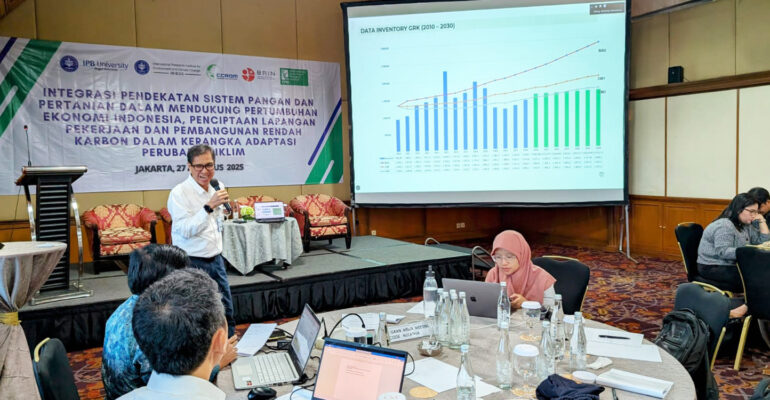
The IPB University International Research Institute for the Environment and Climate Change (LRI-LPI), the National Research and Innovation Agency (BRIN), and the International Food Policy Research Institute (IFPRI) held a workshop on integrating food and agriculture systems approaches.
In his opening remarks, LRI-LPI Chairman, Prof Rizaldi Boer emphasized the importance of integrating food systems and low-carbon agriculture. According to him, the transformation to low-carbon food is not only a matter of production, but also the future of Indonesia’s economy, society, and environment.
“The agricultural sector contributes 10-12 percent of global greenhouse gas emissions. Through this forum, we want to develop concrete strategies towards low-carbon development and net zero emission targets,” he said at the workshop held at the Grand Melia Hotel, Jakarta, at the end of August.
He said that the event aimed to develop a low-carbon agriculture strategy to support economic growth and job creation, while also addressing the challenges of climate change.
IFPRI representative Angga Pradesha added that the workshop served as a platform to gather input for the development of national food policy. “IFPRI is here to ensure that research supports policies that favor farmers and food security,” he explained.
Meanwhile, a representative from the National Development Planning Agency (Bappenas), Puspita Suryaningtyas, reminded the audience of the triple planetary crisis: climate change, biodiversity loss, and pollution. She emphasized the need for agricultural modernization, strengthening downstreaming, and managing food loss, which could currently meet 45% of national food needs if managed properly.
Assistant Deputy for Food Production and Climate Change at the Coordinating Ministry for Economic Affairs, Dr Fajar Nuradi, highlighted the importance of waste-to-energy strategies and farmer welfare.
“Agriculture employs nearly 30 percent of Indonesia’s workforce. Going forward, the momentum of the Conference of the Parties (COP) 30 must be an opportunity to show real action, not just documents,” he said.
In the main session, IFPRI presented the results of a study using the DEWI (Dynamic Economy Wide Model of Indonesia) model, which assessed growth scenarios up to 2045. The simulation results showed that diversifying commodities other than rice has the potential to increase farmers’ incomes while reducing environmental impacts.
The workshop also featured Agent-Based Models experiments for simulating land allocation decision-making between agencies. The simulation results showed that sectoral decisions without coordination have the potential to create trade-offs between economic growth, farmer welfare, and environmental impact.
In addition to food issues, the Directorate of Resource Mobilization for Climate Change Control, Ministry of Environment, presented the progress of the Second Nationally Determined Contribution (SNDC) which targets a 32-43 percent reduction in emissions and is in line with the 2030 FOLU Net-Sink and 2060 Net Zero Emission commitments.
The discussion also highlighted the importance of strengthening the Measurement, Reporting, and Verification (MRV) system in the agricultural sector so that the mitigation contributions of farmers’ activities can be recognized internationally.
The workshop produced initial recommendations in the form of a low-carbon agriculture roadmap, climate-smart agriculture strategies, downstreaming, and integrated funding mechanisms to strengthen food security while reducing emissions. (*/Rz) (IAAS/FMT)