IPB University Invites Summer Course Participants to Observe Biodiversity on Small Islands
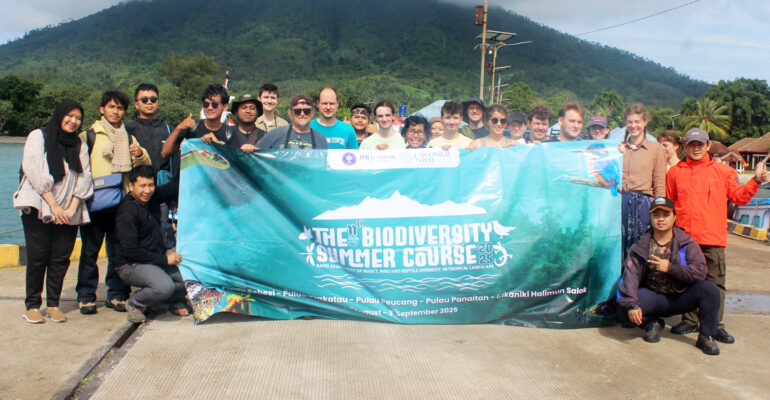
The Department of Plant Protection, Faculty of Agriculture, IPB University, is once again holding a summer course on biodiversity (8/19–9/2).
The 2025 summer course is the 11th edition since it was first held in 2003/2004. This year, 12 students from the University of Vienna, Austria, and 8 students from IPB University, Muhammadiyah University of Yogyakarta, Brawijaya University, and Padjadjaran University, as well as the non-profit organization Indonesian Dragonfly Society (IDS), participated in the course.
IPB University Vice Rector for Global Connectivity, Cooperation, and Alumni, Prof Iskandar Z Siregar, warmly welcomed the participants from Austria. He fully supported this activity because Indonesia, as an archipelagic country, has abundant biodiversity.
Prof Damayanti Buchori, the person in charge of the activity, explained that this summer course was in collaboration with the University of Vienna. This activity focused on observing biodiversity on small islands.
“We set off for Sebesi Island, Krakatau, and Peucang Island. As a comparison with larger islands, we also conducted observations in Gunung Halimun Salak National Park,” said Prof Damayanti Buchori, Professor of Entomology at IPB University.
Prof Damayanti explained that there are four taxa that will be the target of observation during the summer course, namely birds, reptiles, butterflies, and dragonflies. These four taxa were chosen because they play an important role as bioindicators of ecosystem health, while also being easy to observe in the field.
In addition, the diversity and abundance of each taxon can provide an overview of environmental conditions, particularly in relation to habitat quality, resource availability, and the impact of human activities on ecosystem balance.
Prof Christian H Schulze, a supervisor from the University of Vienna, explained that Krakatau and the surrounding islands were chosen as the location for the activity because these islands show the primary succession process from the impact of the Anak Krakatau eruption.
“We will conduct biodiversity observations using the rapid biodiversity assessment method and compare them between islands,” said Prof Christian. (IAAS/KQA)