IPB University Graduate Students Conduct Scientific Field Trip to Study the Ambivalence of the Baduy Luar Community
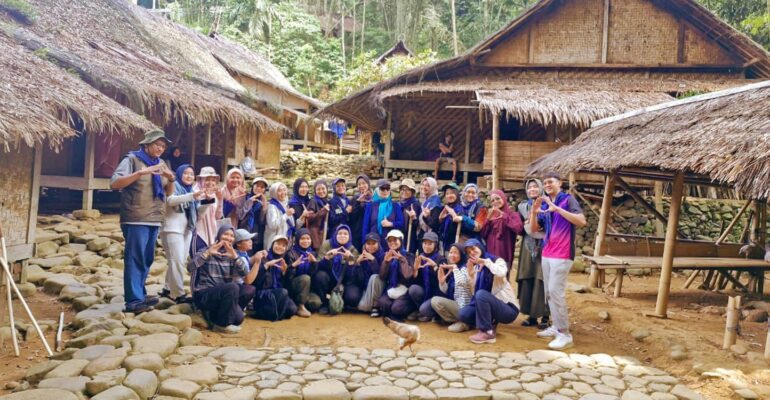
How do traditional families cope with the tide of modernity without losing their cultural roots? This question was addressed by IPB University graduate students through a scientific field trip to the Baduy Luar indigenous community in Banten.
A total of 27 IPB University students from the Master’s Program in Family and Child Development and the Doctoral Program in Family Studies participated. The activity was guided directly by Prof Euis Sunarti, Professor of Family Studies at IPB University and lecturer of Family Resilience and Policy.
The Baduy Luar community is currently in a phase of transition. They are beginning to open up to outside influences, but still strive to preserve the basic cultural values inherited from their ancestors.
From their observations, the students made a number of interesting findings. Prof Euis said that the transition experienced by the Baduy Luar community shows that the family is not a static entity, but rather an adaptive and dynamic entity that responds to the changing times.
The results of the students’ research and observations also show that the Baduy Luar indigenous community does not completely reject technological developments, but regulates their use.
“This ambivalence (a pull between rejection and acceptance in responding to technological developments) shows that there is cultural negotiation within the Baduy Luar indigenous community. It is this attitude that actually strengthens cultural resilience,” said Prof Euis.
Some families have begun to utilize technology for marketing agricultural products such as honey and handicrafts, thereby increasing their income and welfare. However, some of them still maintain their distance and regulate the use of technology such as cell phones so as not to lose their cultural identity.
Thus, the Baduy Luar indigenous families live in a position “in between”: between traditions that they want to preserve and modernity that is difficult to avoid.
According to Prof Euis, this phenomenon can be critically interpreted as a form of cultural resilience. They adapt to technology as needed while remaining steadfast in upholding traditional values without being completely swept away by globalization.
“This pattern confirms that traditional families are not passive parties but active actors who sort through and select developments that are relevant to their values, even if this is not yet done ideally,” she said.
In addition, students also learned many things from the Baduy Luar community.
In terms of family resilience, the Baduy community demonstrates food self-sufficiency through traditional huma field management without chemical fertilizers. In terms of family development, the values of togetherness, mutual cooperation, and deliberation still strongly color their daily lives.
“This reality is an important reflection for students to relate academic concepts to real-world practices,” said Prof Euis.
Through this activity, she said, students gain a direct understanding that resilience, policy, and family development are always closely related to the ecosystem and transitions experienced by a family.
“The visit to the Baduy indigenous community serves as a rich learning experience while fostering appreciation for local wisdom,” she concluded. (*/Rz) (IAAS/KDP)