IPB University Expert: Three Million Hectares of Rice Fields in Indonesia Not Yet Formally Protected
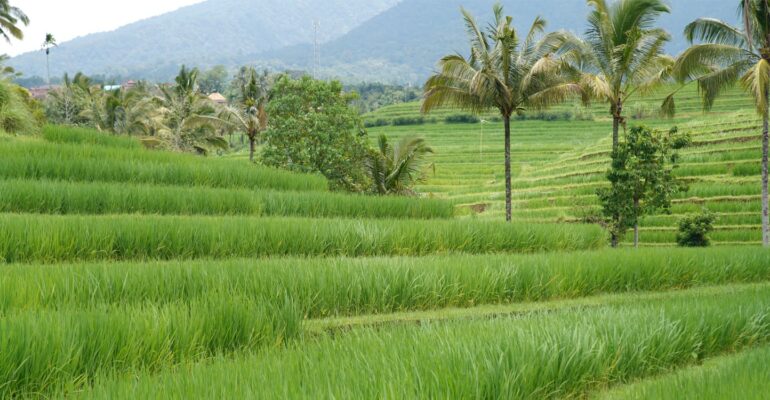
Prof Baba Barus, Professor at the Faculty of Agriculture, IPB University, emphasized the need to protect rice fields as the foundation of Indonesia’s food security. Currently, he noted that there are three million hectares of rice fields in Indonesia that are not yet formally protected.
Prof Baba Barus stressed that the ongoing rate of land conversion must be curbed through firm, consistent, and spatial planning-based policies.
“Indonesia has around 7,3 million hectares of rice fields. In theory, this amount is sufficient. However, in reality, its distribution and utilization are uneven,” said Prof Baba in his presentation at an online discussion held by the IPB University Postgraduate Student Forum.
“Our quick calculations show that 23 provinces are experiencing a deficit, while only 14 provinces have a surplus,” he said.
He added that the issue of food is not only a matter of availability, but also access, distribution, and people’s purchasing power. “If we talk about global figures, Indonesia does not seem to be lacking in rice. However, the issues of distribution and purchasing power are other challenges,” he said.
Furthermore, Prof Baba explained that rice field conversion in Indonesia is estimated to reach 100–150 thousand hectares per year. Land protection policies have actually been in place since the 1990s, including Law No. 41 on Sustainable Food Crop Land Protection (LP2B).
However, implementation in the regions remains weak because many district governments have not seriously included rice field protection in their spatial planning.
“If a rice field is protected, there must be a regional regulation (perda) with a spatial map. Unfortunately, many districts have created regional regulations without maps. As a result, the protection is not effective,” he said.
In addition, around three million hectares of rice fields in Indonesia are not yet included in the category of formally protected land. According to Prof Baba, this condition has the potential to increase land conversion. “If protection is not strong, rice field conversion can occur quickly,” he added.
With more than 20 years of experience studying land protection, Prof Baba emphasized the need to consider critical variables such as water availability, productivity, and farmers’ dependence on land.
“There are areas where farmers are highly dependent on rice fields. If their land is converted, the impact will not only be on food production, but also on farmers’ welfare,” he said.
He also highlighted the challenges of rice field extensification programs, including rice field cultivation in South Papua and Central Kalimantan. Although important, these programs face obstacles such as land claims, soil diversity, and time constraints.
Prof Baba reminded that rice field protection policies must be viewed as a long-term strategy. “If protection is consistent, we can maintain food security while protecting farmers. But if not, the threat of land conversion will continue to loom,” he concluded. (dr) (IAAS/RMH)