
62nd Dies Natalis, IPB University Reaffirms Agromaritime Transformation 5.0
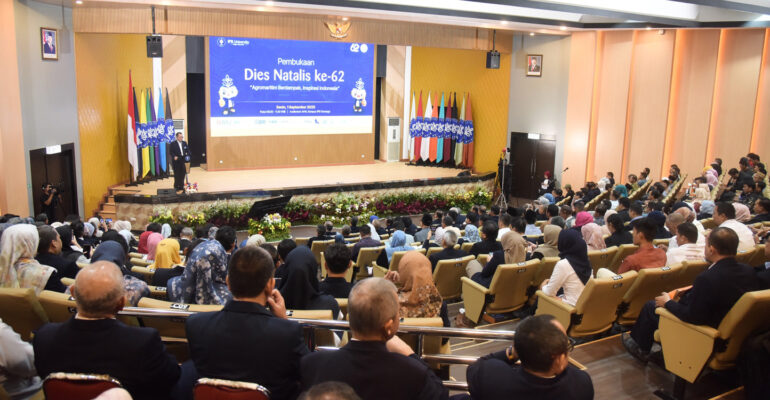
IPB University reaffirmed its commitment to continuous transformation in addressing global challenges while contributing to national stability. This was highlighted during the Opening Ceremony of the 62nd Dies Natalis of IPB University on Monday (9/1).
Chairman of the Board of Trustees (MWA) of IPB University, Prof Hardinsyah, emphasized that the Dies Natalis serves as a moment of reflection to evaluate the journey thus far while improving the direction for the future.
“Since 1963, IPB University has undergone significant development and transformation. Both external and internal conditions demand that we continue to innovate so as not to be left behind other universities, nationally and globally,” he stated.
He likened IPB University to a great ship that requires a precise compass to determine its course. “MWA ensures the direction of this great ship. Only through collaboration, perseverance, and sincerity can we make IPB University move forward stronger and more excellent,” he affirmed.
On the same occasion, Rector of IPB University, Prof Arif Satria, explained that the Agromaritime 4.0 concept launched in 2018 has now been upgraded to Agromaritime 5.0 in response to global trends. This advancement emphasizes three key aspects: the role of humans in technology, the development of Artificial Intelligence (AI), and environmental sustainability.
“Agromaritime 5.0 is the answer to the challenges of the disruptive era, ranging from climate crises to geopolitics. IPB University will focus on AI research, omics research, as well as sustainability and social research as tangible contributions to Indonesia and the world,” Prof Arif explained.
Furthermore, Prof Arif stressed that IPB University is now oriented towards strengthening its reputation, not merely its image. “Image is when we say we are good. Reputation is when others say we are good. Reputation is born from the works, innovations, organization, and real contributions of IPB University to society,” he noted.
He also referred to World Economic Forum research on future skills. In the era of 5.0, skills such as analytical thinking, creativity, leadership, technological literacy, and green skills (climate change mitigation, agroforestry, environmental conservation) will be key competencies.
“Indonesia holds a relatively good position in the digital and AI skills index, even surpassing several countries in the region. However, we must not be complacent. Higher education must continue to produce talents with relevant skills for the future,” he concluded. (AS) (IAAS/NVA).

