
SBY’s Public Lecture at IPB University: Food and Climate Determine the Future of the World
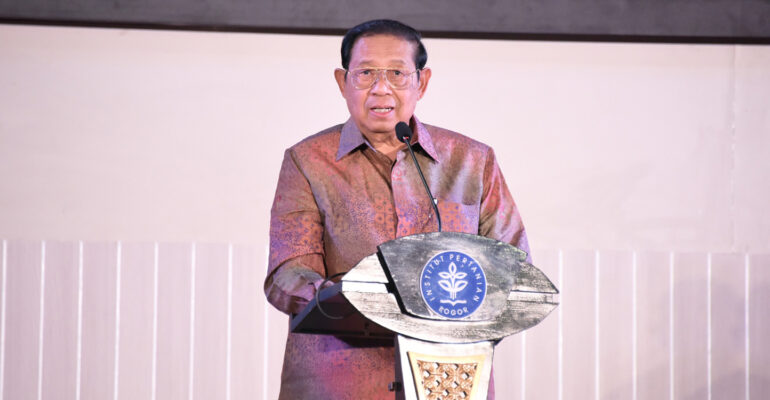
The 6th President of the Republic of Indonesia, Prof. Susilo Bambang Yudhoyono (SBY), returned to his alma mater, IPB University. He came to deliver a public lecture for the academic community, especially new students of the IPB University Graduate School.
During the public lecture, which was held in conjunction with the 50th anniversary of the Graduate School, SBY expressed his pride in being part of the IPB University family.
He recounted his decision to study at the Doctoral Program in Agricultural Economics at IPB University. SBY said that his decision was based on his interest in development economics, food security, poverty alleviation, and reducing unemployment.
“The content of this dissertation ultimately became an important element in the government’s economic vision and policies during my 10 years in office, with a sustainable growth strategy that was pro-growth, pro-job, pro-poor, and pro-environment,” said SBY.
As a result, during 2004–2014, the average economic growth rate was 6 percent per year, Gross Domestic Product (GDP) increased by 400 percent, per capita income rose by 350 percent, poverty decreased from 17 percent to around 10 percent, and unemployment fell from 9–10 percent to 6 percent.
“IPB University has a historical contribution, because IPB University educated me to build the economy for 10 years, and thank God, the results are also tangible,” he said.
SBY also expressed his hope that IPB University will continue to be a world class university and center of excellence in the fields of food and climate. “No food, no life,” was his meaningful message. “The future of the world depends on food security and sustainability.”
On the same occasion, Rector Prof. Arif Satria emphasized IPB University’s commitment to realizing its vision of becoming an innovative and resilient university that brings progress to the nation. This vision, according to him, is rooted in the development of the industrial revolution, which is now entering the era of Society 5.0.
“The concept combines digitalization, automation, and artificial intelligence (AI) with the principles of sustainability, resilience, and a human-centric approach,” he said.
Prof Arif explained that IPB’s vision for 2024–2028 is to become an innovative and resilient university, building a globally competitive socio-principal university in the fields of agriculture, marine, and tropical bioscience.
“In 2025, the theme of IPB University’s work program is Entrepreneurship and Value Creation for Community and Industry. The target is for IPB University to become a global leader in entrepreneurship by 2027,” he said.
Dean of the IPB University Graduate School, Prof Dodik Ridho Nurrochmat, explained that for 50 years, the Graduate School has been home to thinkers, researchers, and leaders who respond to the challenges of the times through science, public policy, and social innovation.
He noted that there are over 100 interdisciplinary programs, including 57 master’s programs, 43 doctoral programs, and one professional postgraduate program under the coordination of the Graduate School of IPB University.
“Currently, the total number of active students in the Graduate School for the odd semester is 7.281. Interestingly, the youngest student is in their teens, while the oldest student, aged 84, is still actively pursuing knowledge at IPB University,” he said. (dr) (IAAS/LAN)

