Researchers from 7 Countries Attend Biomass and Bioenergy Discussion at IPB University
Indonesia is currently undergoing a transition towards environmentally friendly and zero emission energy. Responding to this opportunity, IPB University emphasizes the need for research and innovation in supporting national energy security.
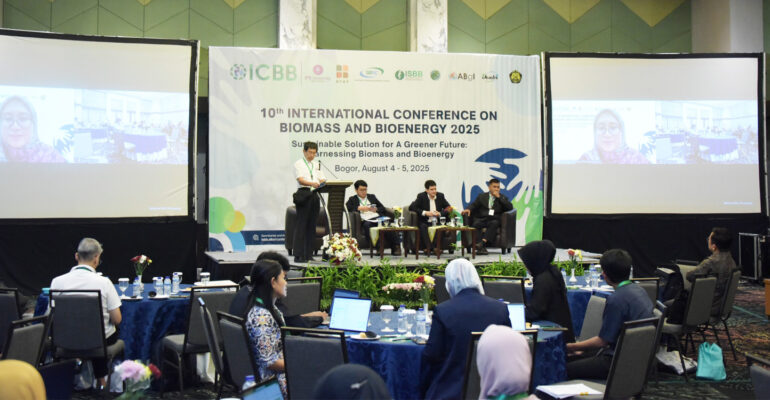
This was revealed during the 10th International Conference on Bioenergy and Biomass (ICBB) organized by the Surfactant and Bioenergy Research Center (SBRC) at the IPB International Convention Center (IICC), Bogor (4–5/8).
“Indonesia is currently undergoing an energy transition toward environmentally friendly energy. Therefore, we have chosen the overarching theme of the sustainable future of Indonesia’s energy security through the utilization of biomass and bioenergy,” said Dr Meika Syahbana Rusli, Chairman of the SBRC at IPB University.
The 10th ICBB was attended by participants from seven countries. This year, the conference also involved collaboration with the International Society for Biomass and Bioenergy.
Dr Meika continued that one of the topics in this forum was the development of Sustainable Aviation Fuel (SAF), which is considered a major challenge and strategic opportunity for Indonesia.
He mentioned that Indonesia has shown progress in the development of biofuel, especially in the biodiesel sector. However, SAF still faces technical, economic, and logistical challenges.
“We have made considerable progress in the development of biodiesel. However, there are still many challenges for SAF. Our roadmap for next year is to start implementing 1% SAF of total fuel, then 2,5% in 2030, and 5% in 2035. These are not easy targets,” he explained.
Dr Meika said that SBRC IPB University is also exploring technology for converting solid biomass into bio-oil through a gasification process. Airbus Singapore has shown interest in this approach because lipid sources for SAF will become limited starting in 2030, making biomass the main alternative.
“Airbus has expressed interest because the supply of used oil will be limited. They project that future SAF production must be biomass-based,” he said.
Director of Bioenergy, Directorate General of New, Renewable Energy and Energy Conservation, Ministry of Energy and Mineral Resources (ESDM), Edi Wibowo, MSi, emphasized that the government is currently drafting various regulations to support the development of bioenergy.
“This bioenergy is for domestic needs. We want to maximize this potential to support national energy independence and security,” he said.
On this occasion, the Vice Rector for Research, Innovation, and Agromaritime Development at IPB University, Prof Ernan Rustiadi, was also present. He appreciated the hard work of the committee and the contributions of national and international partners.
“Our earth is rich in biological resources in terms of quantity and diversity, which have great potential to be converted into bioenergy,” he said.
Arfie Thahar, Chief of the Plantation Fund Management Agency (BPDP) Service Division, explained that Indonesia had conducted a bioavtur trial in 2024 using palm kernel with a mixture of 2,4 percent.
The trial was conducted on a Garuda Indonesia flight from Jakarta to Solo and was declared a success. (dr) (IAAS/LAN)