Nvidia Says Physics is the Foundation of AI, IPB University Professor: 80 Percent of Modern Technology was Born from Quantum Theory
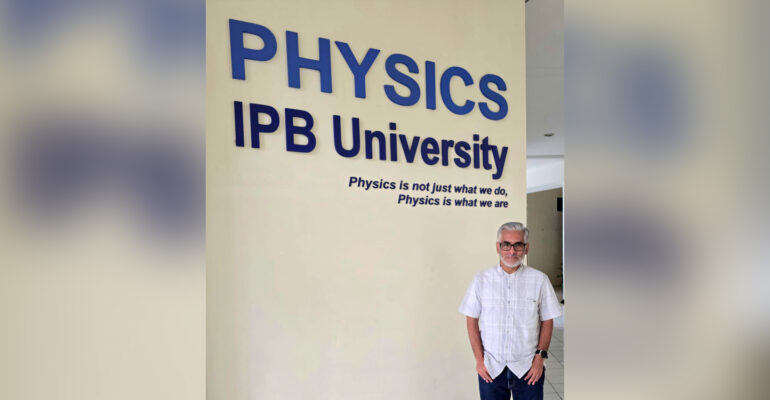
Quantum theory has given rise to nearly 80 percent of the modern technology that humans use today, including smartphones and artificial intelligence (AI) technology. This fact was revealed by IPB University Professor of Theoretical Physics, Prof Husin Alatas, in response to Nvidia CEO Jensen Huang’s statement about the importance of physics in the era of artificial intelligence.
“In the last hundred years, quantum theory has given birth to nearly 80 percent of modern technology,” said Prof Husin. The smartphones we hold every day are powered by processors built from transistor units measuring less than 10 nanometers—a technology that is only possible thanks to an understanding of quantum physics.
Intuition-Imagination Ability
Slightly different from other branches of science that rely on three abilities: observing and measuring, performing mathematical analysis, and relying on rationality; physics also has another foundation, namely relying on sharp intuition-imagination.
“It is this intuition-imagination that enables physics to produce many technological breakthroughs that have shaped recent civilization,” he said.
Prof Husin explained that physics is a scientific discipline whose scope ranges from the microscopic to the mesoscopic to the macroscopic. Its field of study ranges from elementary particles measuring one meter divided by one billion billion to the universe measuring one hundred trillion trillion meters.
The Theory of Relativity and Quantum Theory
Prof Husin cited two extreme examples, namely the theory of relativity and quantum theory. Both theories are related to the microscopic and macroscopic scales, respectively, dealing with objects that are beyond the ability of human senses to observe.
“Electrons and galaxies are two objects that certainly cannot be observed directly. This is different from, for example, living things that are the objects of the discipline of biology,” said the lecturer of the Advanced Relativity Theory and Quantum Physics course in the Physics Undergraduate Program at IPB University.
Relativity theory examines various unique natural phenomena. This theory studies objects moving at extremely high speeds, approaching the speed of light. Additionally, it also discusses objects with very large masses, such as planets and stars.
According to Prof Husin, relativity theory is based on two assumptions. First, the speed of light in a vacuum is a universal constant. This means that the speed of light is always the same for all observers, regardless of how fast they are moving.
The second assumption is more complex. Prof Husin explained that observers in a non-inertial reference frame (experiencing acceleration) cannot distinguish whether they are being accelerated or are in a strong gravitational field. In other words, the effects of acceleration and gravity give the same sensation to observers.
“These assumptions, in relation to current applications, have become the basis for several technologies such as the Global Positioning System (GPS), Positron-Electron Emission Tomography (PET), and nuclear technology,” he said.
On the other hand, quantum theory is based on several assumptions that are imaginative and contrary to human everyday experience. In the past hundred years, this theory has given birth to nearly 80 percent of modern technology, one of which is the smartphone.
“Smartphone processors are built from transistor units measuring less than 10 nanometers. At this size, the behavior of electrons flowing inside them is predicted very well by quantum theory,” added Prof Husin.
Another unique feature is that quantum theory also explains that an electron or photon (light particle) can have both wave and particle properties.
“The intuitive-imaginative explanation provided by quantum theory has opened up vast opportunities for its application, including in the design of nanometer-sized semiconductor chips,” he said.
Based on this intuitive-imaginative ability, said Prof Husin, Jensen Huang’s statement can be understood. Physics offers almost unlimited opportunities for creativity in technological development and forms the basis for the birth of new disruptive technologies.
“This is reflected in various technologies that were unimaginable a hundred years ago but have proven to be achievable. This includes providing opportunities for the birth of artificial intelligence technology, which has the potential to render other disciplines less necessary,” he concluded. (dr) (IAAS/FMT)