Many Students and Teachers Withdraw from Sekolah Rakyat, IPB University Experts Give This Input
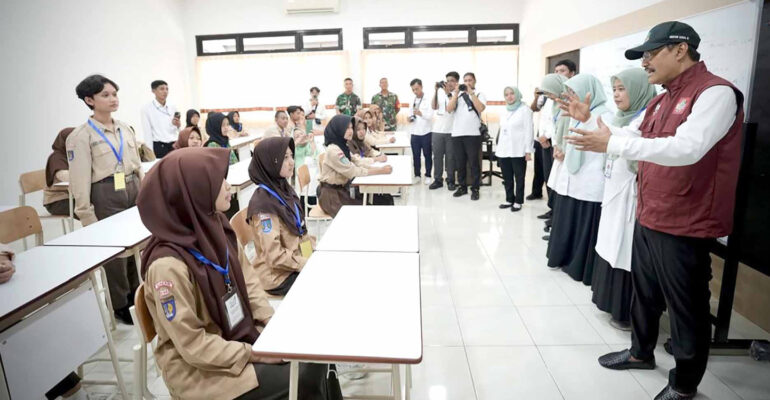
The number of students withdrawing from the Sekolah Rakyat program has sparked concern among academics. One of them is an expert in rural sociology and community development from IPB University, Prof Lala M Kolopaking.
Prof Lala considers that this issue shows the need for a deeper socio-cultural approach and participatory community involvement from the start.
“The Sekolah Rakyat program has a very good purpose, to help underprivileged people. But there should be a socio-cultural mapping first, so that this program touches the needs and character of the local community,” said Prof Lala.
The professor of the Department of Communication Science and Community Development, Faculty of Human Ecology (Fema) IPB University emphasized the importance of making the community a subject, not just an object of program recipients.
“This is a signal that making a good program is not enough just by intention, but it must be allocated to the surrounding community with a dialogue approach. So there is a dialog that is built, so that they understand,” he said.
According to him, the absence of a participatory approach could be the main cause of student retention. “If they say they don’t feel at home, it could be that the people who go to school there are indeed far from the local culture. It could be that they experience homesickness,” he explained.
Potential, But Need Assistance
Responding to the boarding school model used in some Folk Schools, Prof Lala assessed that this method is actually suitable for children from vulnerable families in the village. “Boarding is a choice of educational methods, which can form a stronger character,” he said.
However, he underlines that adaptation is a big challenge in this model. “People leaving home need adaptation assistance. They cannot be immediately forced to enter the dormitory without social preparation to the psychological aspects of those who will learn,” he said.
The key to the success of boarding schools, according to him, lies in the initial process-dialogue, social mapping, and student selection that considers their socio-cultural conditions.
“As long as the process is done by involving the community from the beginning, the school will be more easily accepted. Don’t let everything be decided from above without considering the competencies and contextual intelligence that will be achieved.”
Dialogical Communication is the Foundation
To make Sekolah Rakyat more acceptable, Prof Lala emphasized the need for dialogical communication since planning. “Communication is a dialog. We must prepare the surrounding community for the presence of the school,” he explained.
He criticized the top-down affirmative approach that tends to be instructive. “It needs to be equipped with a liberating education model. The school needs to be prepared together with interested parties from the beginning.
According to him, this dialog is important to create a shared awareness that schools are not just physical buildings, but also a means of building the future. “Don’t just look at physical facilities, but also the psychological understanding of stakeholders,” he said.
Clarity of Definition-Relevance of Curriculum
To ensure the sustainability of Sekolah Rakyat, Prof Lala emphasizes two things: the clarity of the definition of “poor” and the relevance of the curriculum to the potential of the local economy.
“It must be clear first, is the disadvantage economic, access, or academic? Then most importantly, the curriculum must be adapted to the student’s environment,” he said.
For example, schools in rubber plantation areas should teach general material and introduce skills around rubber industrialization. While schools in coastal areas receive additional focus on maritime sector industrialization. “So that from the beginning, the school knows that it has the awareness to become a driver of the local economy and its own life,” he said.
Finally, he reminded that teacher readiness must also be considered. Teachers need to understand the local socio-cultural context in which they teach in order to provide the right education for students.
For sustainable education solutions, the human inquiry approach and adaptive local ecosystems are the keys to successful programs such as Sekolah Rakyat. (Fj) (IAAS/KQA)