
IPB University: Soil Health Issues Become Challenges for Modern Landscapes
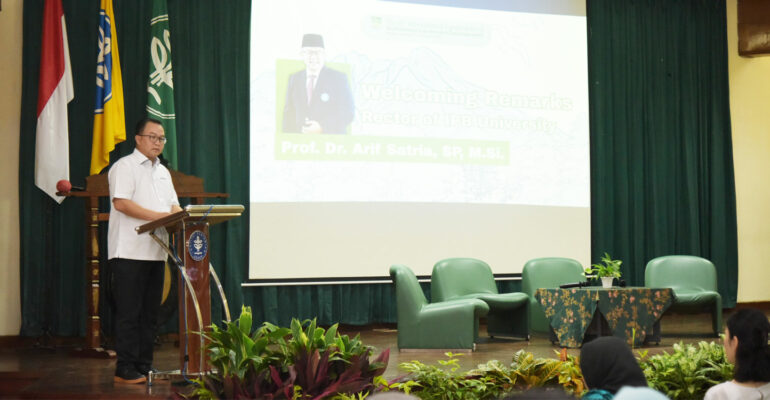
As a form of encouragement for the importance of research in sustainable landscape development, the Department of Landscape Architecture, Faculty of Agriculture, IPB University held an International Symposium for Sustainable Landscape Development.
During the event held at the Toyib Hadiwijaya Auditorium, IPB University Dramaga Campus (8/6), IPB University Rector Prof Arif Satria emphasized the importance of a regenerative approach in landscape architecture. This is in response to global challenges such as climate change, soil degradation, and environmental sustainability.
“We are now facing serious challenges, including climate change, unsustainable land use, and the importance of community involvement in creating healthier and more adaptive landscapes,” said Prof Arif.
Furthermore, issues related to soil health are major challenges that modern landscape architecture must address. “In the past, landscape architecture was considered merely gardening or spatial aesthetics, but now it has evolved into a field closely related to social, economic, and technological issues.”
“We are talking about population dynamics, regional development issues, and even politics,” he reiterated.
In addition, he emphasized the importance of international collaboration and knowledge exchange as part of IPB University’s commitment to promoting landscape architecture towards a more sustainable future.
“I want this to be a moment to open up international horizons and I encourage meaningful collaboration for a shared future,” concluded Prof Arif.
In line with this, the Chairman of the Department of Landscape Architecture at IPB University, Dr Akhmad Arifin Hadi, emphasized that currently, research related to landscape is still minimal, both in Indonesia and globally.
“Many developments do not pay attention to landscape research, so they end up neglected. This often happens in new cities and rural areas,” said Dr Arifin.
He added that apart from being an academic discussion forum, this event also serves as a platform to strengthen international cooperation and to campaign for the importance of landscape research to the government and other stakeholders.
“We cannot carry out landscape research alone. Collaboration with professors and universities abroad is very important,” he explained.
Currently, IPB University has established international collaborations with renowned universities such as Chiba University, Kyoto University, Warsaw University of Technology, Universiti Putra Malaysia, and the University of the Philippines Diliman. The collaborations include student and faculty exchanges, as well as double degree programs.
“Six faculty members have been sent to Poland, and six Polish faculty members will visit Indonesia. Two students have participated in the double degree program at Kyoto University. IPB University also plans to launch an international master’s program in Landscape Architecture, with the goal of sending 12 students to Poland next year,” he concluded. (AS) (IAAS/LAN)

