IPB University Researcher: Wasps Are More Dangerous Than Bees, Here’s the Scientific Reason
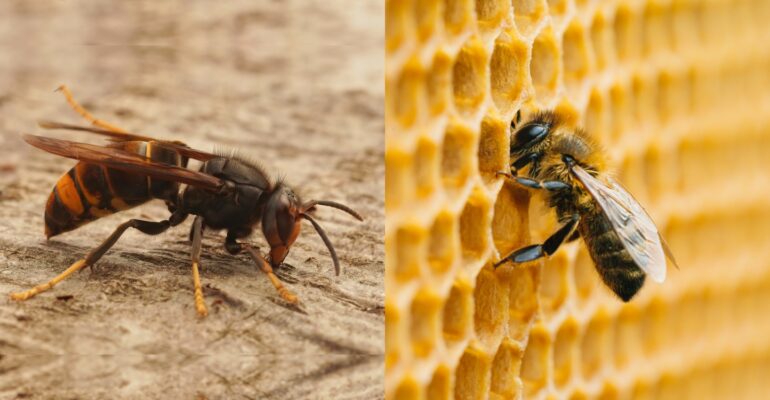
Wasps are far more dangerous to humans than bees because of their deadly stings. A single wasp can sting multiple times with a stronger venom, while bees can only sting once.
This was revealed by Prof Tri Atmowidi, an expert from the Department of Biology at IPB University, in a written interview at the IPB Dramaga Campus, Bogor (8/25). He explained the fundamental differences between these two small insects.
“When disturbed, wasps and bees will sting as a form of self-defense,” explained Prof Tri. “Wasps’ stings are more dangerous because they can sting multiple times. The stinger does not detach from their body after stinging.”
Unlike bees, whose stingers detach after stinging their target. “After stinging, the bee’s stinger remains attached to the stung area and detaches from the bee’s body. Therefore, a single bee can only sting once,” he added.
Although bee venom is reported to be more abundant than wasp venom, wasp venom is stronger and can be injected multiple times. “Vespa wasp stings can cause serious toxic reactions in humans, and can even cause death,” said Prof Tri.
Physical Differences
Prof Tri explained an easy way to visually distinguish between the two insects. Taxonomically, bees belong to the Apiformes group, while wasps belong to the Spheciformes group.
“Morphologically, the two are easy to distinguish. Bees have very hairy bodies, including their legs, while wasps tend to have less hair.”
In terms of color, bees vary in color, such as brown, black, and some with stripes on their abdomen. Wasps are generally brown with variations in stripes on their abdomen.
There are hundreds of species of bees. Common examples are honey bees (Apis cerana and Apis mellifera) and stingless bees (klanceng, teuweul), which are widely cultivated in Indonesia. Examples of wasps include the Asian giant hornet (Vespa velutina) and the Asian giant hornet (Vespa affinis).
Herbivores vs Predators
Another fundamental difference lies in their feeding behavior. Bees are herbivores (plant eaters), primarily consuming nectar and pollen. “This is in line with their mouthparts, which are designed to suck liquids and chew using their mandibles,” explained Prof Tri.
Bees are very active in searching for food sources for their own needs and to feed the larvae in the hive. They store pollen and honey (nectar that has been processed in their stomachs) in the hive as food reserves.
In contrast, wasps are predators that eat insects and other small animals. “Wasps are also quite active in hunting prey because they are social insects that feed their larvae in the hive,” he explained.
Economically, bees are far more valuable than wasps. Bees produce various high-value products such as honey, which contains many enzymes and sugars; pollen, which is rich in protein; propolis, which has antibacterial and antifungal properties; and royal jelly, which is a source of nutrients.
Honeybees also produce wax that has commercial value. Even bee venom can be used in medical therapy. “Wasps tend to produce little honey and pollen. Polistes wasp venom can also be used for medical therapy,” added Prof Tri.
Both bees and wasps tend to inhabit similar habitats, namely areas where there are food sources and materials for building nests. Wasps and Apis cerana honey bees can be found in villages and gardens with a variety of trees as food sources.
Both insects reproduce in nests and are social insects that develop a caste system (queen, male, worker). (dh) (IAAS/NRA)