
IPB University Academics Visit Cilacap Regent to Discuss Waste as a Center for Education and Innovation
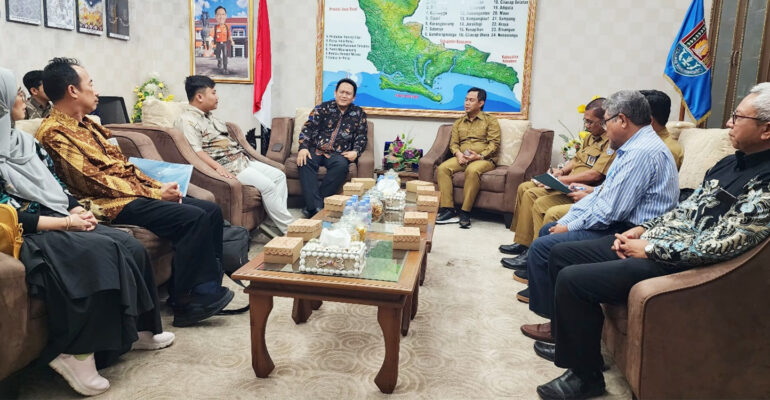
Academics from IPB University, Universitas Persada Indonesia YAI, and Bakrie University held a meeting with the Regent of Cilacap. The visit was to discuss plans for developing an Eco-Edu-Park in the Refuse Derived Fuel (RDF) Plant area in Cilacap, Central Java.
This activity is part of a collaborative effort between academics and the regional government to make waste management a center for sustainable education and innovation. These academics are part of a research program under the 2025 Strategic Research Collaboration (Katalis) scheme.
According to the Regent of Cilacap, RDF has proven to be an effective waste management solution in the region. The program is suitable for replication in areas that have cement plants.
“We are trying to encourage RDF management for waste that can be processed so that the remaining waste is further reduced. RDF is suitable for replication in regions with cement plants that are willing to collaborate,” said the Regent.
He stated that waste management must continue to be optimized, including by ensuring that the waste transportation system operates optimally so that the RDF can receive and process more waste.
Regarding the development of the Eco-Edu-Park, he revealed that the idea was actually an old concept. However, the COVID-19 pandemic halted the program.
“We manage waste through RDF, composting, and maggot cultivation. Hopefully, all of this can serve as an educational tool. We still want to push for this,” he added.
Prof A Faroby Falatehan, Professor at the Faculty of Economics and Management, IPB University, emphasized the importance of establishing a baseline for waste management and long-term carbon emission reduction during the meeting.
“We can establish a baseline for the next 10 years, for example regarding carbon emission reduction. Later, this reduction can be calculated and claimed in the form of certificates that companies can purchase,” explained the lecturer from the Department of Resource and Environmental Economics (ESL), IPB University.
Furthermore, Prof A Faroby, who is also the Chairman of the Regional Development Management Master’s Program at IPB University, stressed the importance of the economic and environmental sustainability of RDF.
“The hope is that RDF can operate sustainably and provide economic added value. If managed properly, RDF not only reduces the waste burden but can also create new economic opportunities through carbon credits and the use of processed products,” he added.
Meanwhile, Dr Kun Nasython from Bakrie University highlighted the need for sustainability strategies for RDF facilities, which have a certain technical lifespan. He shared initial findings from a study being conducted in Bantargebang regarding the optimization and shifting of equipment operation.
“RDF has a technical lifespan. We are conducting optimization studies, including through shifting operational equipment. RDF based on carbon calculations can claim its carbon footprint,” explained Dr Kun.
The potential for renewable energy in Cilacap was also highlighted in this meeting. With biomass from post-harvest rice sludge in Central Java reaching millions of tons, the opportunity to utilize it as fuel for PLTU pellets is very open.
In addition, the potential to develop energy crops such as calliandra and the utilization of mangrove tourism areas further support Cilacap’s direction towards integrated and productive environmental management. (*/Rz) (IAAS/EXC)

