Housing Proliferation in Vulnerable Areas, IPB University Spatial Planning Expert: There is a Gap Between Reality and Needs
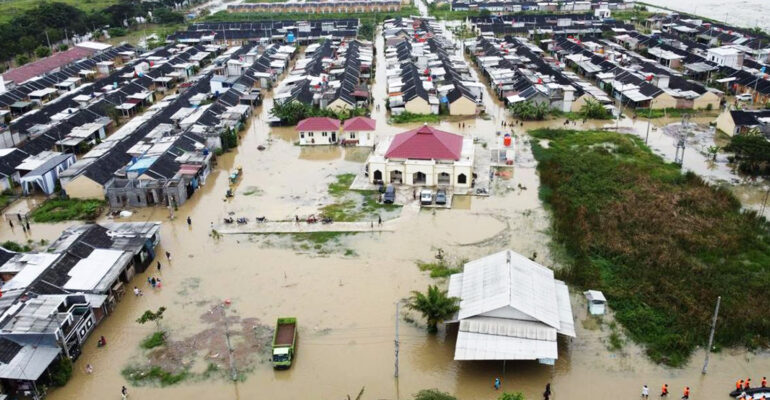
The issue of increasing housing needs often does not align with the reality on the ground. Many settlements are built in locations that are actually unfit for habitation, such as flood-prone areas or areas with low carrying capacity.
According to Dr Akhmad Arifin Hadi, Chairman of the Landscape Architecture Department at IPB University, both developers and individuals must adhere to the spatial planning guidelines set by the government.
“Within that spatial planning framework, the government has already allocated areas suitable for residential development. However, if settlements are instead built in flood-prone areas, then the spatial planning needs to be reviewed,” he said.
He added that such issues can arise because the data used in spatial planning is not accurate, valid, or up-to-date. “If the data is of poor quality, the spatial planning results will be inaccurate. Therefore, the government must use data that is truly reliable,” he emphasized.
Additionally, Dr Akhmad highlighted the gap between housing needs and the reality of sustainable residential areas. He explained that when determining residential zones, aspects such as topography, soil type, hydrology, and infrastructure networks must be considered comprehensively.
Furthermore, he warned that development that ignores ecological aspects can trigger new problems, such as wildlife disturbances or habitat destruction. He cited the example of residential development in wildlife migration areas, which ultimately caused wildlife to migrate to agricultural land and become pests.
Regarding regulations, Dr Akhmad stated that policies on residential development already exist. The challenge is how to implement these policies consistently.
“If an area lacks the capacity to support residential development, it should not be designated as a residential zone. Don’t just build houses there because there’s a land certificate without considering the landscape aspects,” he said.
He emphasized that the landscape is an interconnected living system. Communities must realize that building a house also means interacting with water, sunlight, wind, and the physical characteristics of the surrounding land.
Addressing the issue of settlements already built in unsuitable locations, Dr Akhmad explained there are two approaches. If the problem is major, such as extreme topography or being in a waterway, the area should be returned to a protected zone.
“For example, flood-prone areas that naturally collect water should be restored as forests. Otherwise, the costs of modification and landscape management will be extremely high,” he explained.
However, if the issue is minor, solutions can still be implemented through landscape engineering, such as adding soil or installing small-scale drainage systems.
Dr Akhmad also emphasized the importance of the government developing spatial planning based on valid data that is open to the public. The public is also urged not to violate established spatial planning regulations.
“The spatial planning law already stipulates penalties for violators. Let us all comply together, for the comfort and sustainability of the environment,” he concluded. (AS) (IAAS/ASY)