Learn the Differences Between Nile Tilapia and Tilapia Fish, According to a Lecturer at IPB University
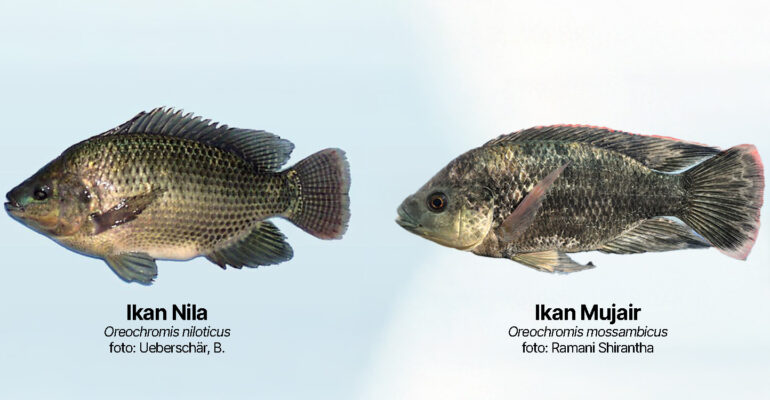
Having trouble distinguishing between nile tilapia and tilapia fish? Both are indeed popular dishes on the dinner table, but they actually belong to different species.
Kurnia Anggraini Rahmi, MSc, a lecturer at the Department of Aquaculture, Faculty of Fisheries and Marine Sciences (FPIK) at IPB University, explains that morphologically and biologically, the two species have significant differences.
She explains that nile tilapia (Oreochromis niloticus) has a round, flat body with a slightly elevated back. A straight line runs clearly along the tail fin and dorsal fin. The body color of tilapia tends to be dark grayish-black with large, rough scales.
“The head of the nile tilapia is relatively small compared to the size of its mouth, but its eyes are large and prominent,” she said.
Kurnia further explained that nile tilapia have a medium-sized snout, cycloid scales, and three rows of scales on the cheek area. “Other characteristics include blunt dorsal and anal fins, while the pectoral fins are pointed.”
“The tail fin displays narrow vertical lines, and there are dark spots at the corners of the operculum,” she added. In terms of scientific identification, the nile tilapia has the following fin formula: D XV.10; C 0.17; A VIII.10; P I.5; and V II.10
Not only in terms of morphology, the reproductive capacity of nile tilapia is also impressive. Tilapia can spawn every 14 days repeatedly, approximately 2-3 times before the tilapia undergoes a maturation period. If during the spawning period the nile tilapia incubates its eggs, one spawning cycle can last for one month.
On the other hand, tilapia fish (Oreochromis mossambicus) exhibit different morphological characteristics. The dorsal fin of tilapia fish is generally black with reddish tips, and the caudal fin lacks stripe patterns.
Tilapia fish have smooth pharyngeal teeth, as well as distinctive jaw and head shapes, particularly in adult males during the reproductive period.
“Adult males have a concave upper head, a black body color, and a white lower head. The edges of the dorsal fin and tail fin appear reddish,” said Kurnia.
Meanwhile, females and young tilapia fish exhibit striped and spotted patterns on the middle of the body and back. The fin formula for tilapia fish is D XVII.12; C 0.20; A III.10; P II.24; and V III.10.
In terms of reproduction, nile tilapia and tilapia fish are not significantly different. Male mujair build nests as spawning sites. Females can produce up to 1.775 mature eggs that hatch within 3 to 5 days. Interestingly, the fry (young fish) remain in the mother’s mouth for an additional week after being released.
“Tilapia fish spawning can occur more than once in a single season, depending on environmental conditions. In fact, this species can reproduce in waters with high salinity levels between 35 and 49 ppt,” he said. (dr) (IAAS/Ard)